PersonThe Progressive Era and World War I
W. E. B. Du Bois
Scholar, editor, and co-founder of the NAACP
1868 (disputed)–1963
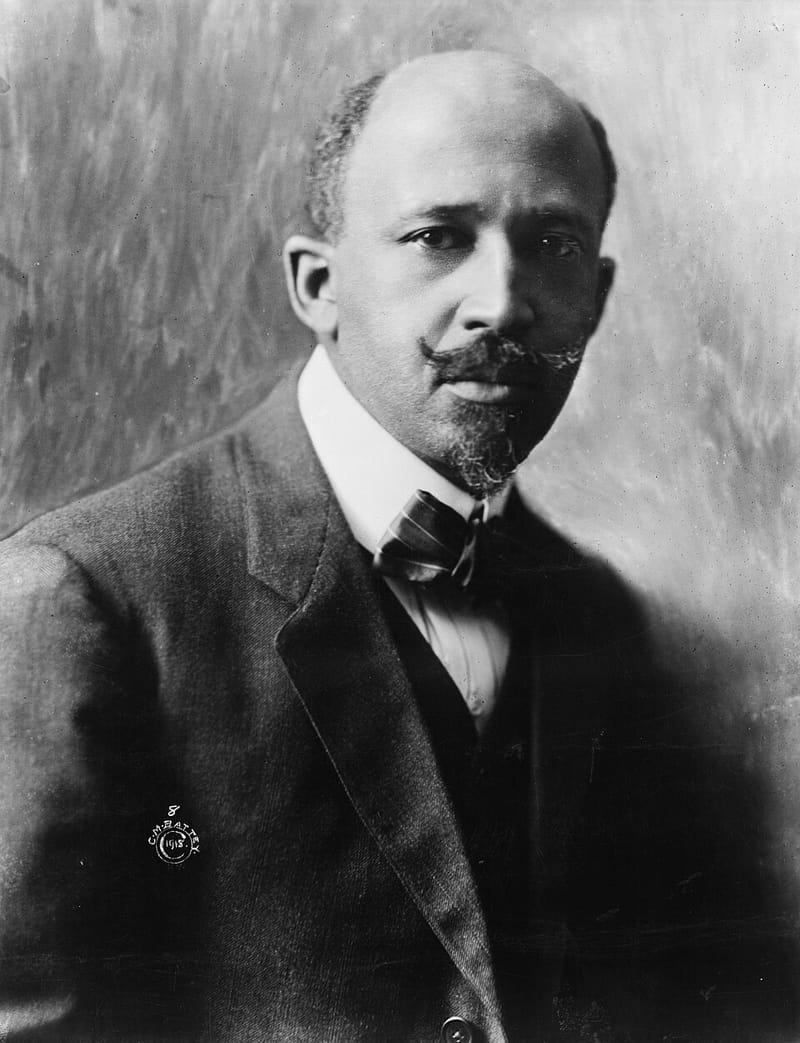
W. E. B. Du Bois was the foremost Black intellectual of the early twentieth century and the most uncompromising voice for civil rights of his era. The first African American to earn a PhD at Harvard, he pioneered the sociological study of Black life, wrote The Souls of Black Folk (1903), and challenged Booker T. Washington’s accommodation to segregation. He founded the Niagara Movement, helped found the NAACP, and for nearly a quarter century edited its magazine, The Crisis. He is widely regarded as a father of both the modern civil rights movement and the international Pan-African movement.
Key facts
- Born
- 1868 (disputed), Great Barrington, Massachusetts
- Died
- 1963
- Roles
- Sociologist and historian; Co-founder of the Niagara Movement (1905) and the NAACP (1909); Editor of The Crisis; Pan-Africanist
- Born
- 1868 in Great Barrington, Massachusetts (some sources give 1869)
- Education
- Fisk University; first African American Ph.D. from Harvard
- Organizations
- Niagara Movement (1905); NAACP (1909)
- Major works
- The Philadelphia Negro, The Souls of Black Folk (1903), Black Reconstruction (1935)
Why it matters
Du Bois gave the twentieth-century struggle for Black civil rights its intellectual foundations and its most uncompromising demand: nothing less than full equality.
Early life and context
William Edward Burghardt Du Bois was born in 1868 in Great Barrington, Massachusetts, five years after the Emancipation Proclamation, into a family that had lived in the area for generations — the small farmhouse near the Housatonic River where he spent his early years had been in his mother’s family for more than 150 years. Raised mainly by his hardworking, independent mother, he learned about race in a New England town even as he gained an abiding faith in education. As a teenager he reported on local politics as a correspondent for a newspaper and devoured history and philosophy at the town bookstore, and he graduated as valedictorian of Great Barrington High School.
At Fisk University in Nashville in the 1880s he encountered the Jim Crow South, an experience that set his life’s work: the study of what he called the “Negro problem,” which he predicted would be the problem of the twentieth century. He then earned a second bachelor’s degree at Harvard, studied in Germany, and in 1895 became the first African American to receive a Harvard PhD.
Major actions and achievements
Teaching at Wilberforce University and Atlanta University, Du Bois produced studies of the transatlantic slave trade and of Black urban life; The Philadelphia Negro and his surveys for the U.S. Bureau of Labor in the late 1890s brought statistical analysis into American sociology. The Souls of Black Folk (1903), blending history and literary drama, became his most famous book; its chapter “Of Mr. Booker T. Washington” openly attacked the era’s most powerful Black leader.
In 1905 Du Bois founded the Niagara Movement to demand full civil and political rights. After a deadly race riot in Springfield, Illinois, in 1908, he was one of seven African Americans among some sixty signers of the call that created the National Association for the Advancement of Colored People in 1909 — and the only Black member of its original executives. As its director of publications and research he founded The Crisis in 1910 and edited it until 1934, making it one of the country’s leading Black publications. He kept writing — Darkwater (1920), novels, and Black Reconstruction in America (1935), which challenged the prevailing racist histories of the Reconstruction era.
Beliefs and ideas
Du Bois rejected every compromise with white supremacy. “We refuse to allow the impression to remain that the Negro-American assents to inferiority, is submissive under oppression and apologetic before insults,” the Niagara Movement’s 1905 Declaration of Principles proclaimed; “Persistent manly agitation is the way to liberty.” He believed in social science as a weapon against racism, in higher education for Black leaders, and in full equality under the law. In later life he joined the worldwide struggle against colonialism, linking American racism to the European imperial tradition.
Controversies, limits, and criticism
Du Bois’s feud with Booker T. Washington split Black leadership for years; Washington’s allies funded newspapers to counter him, while Du Bois accused Washington of having “implicitly abandoned all political and social rights.” Marcus Garvey, in turn, criticized what he saw as Du Bois’s elitist strategies. His later radicalism made him a controversial figure during the Cold War. Even late in life he could joke about his rival’s shadow: “Washington … died in 1915. A lot of people think I died at the same time.”
Legacy
Du Bois died in 1963. His books — The Souls of Black Folk, The Philadelphia Negro, Black Reconstruction — helped transform the study of African American history and establish sociology as an academic discipline, and the NAACP he helped found became the nation’s largest civil rights organization. The site of his childhood home in Great Barrington was designated a National Historic Landmark in 1979.
Study this entry
Check your understanding
Try answering in your own words, then open the answer.
1.What shaped W. E. B. Du Bois early in life?Show answerHide
William Edward Burghardt Du Bois was born in 1868 in Great Barrington, Massachusetts, five years after the Emancipation Proclamation, into a family that had lived in the area for generations — the small farmhouse near the Housatonic River where he spent his early years had been in his mother’s family for more than 150 years.From “Early life and context” above.
2.What were W. E. B. Du Bois’s major achievements?Show answerHide
Teaching at Wilberforce University and Atlanta University, Du Bois produced studies of the transatlantic slave trade and of Black urban life; The Philadelphia Negro and his surveys for the U.S. Bureau of Labor in the late 1890s brought statistical analysis into American sociology. The Souls of Black Folk (1903), blending history and literary drama, became his most famous book; its chapter “Of Mr. Booker T. Washington” openly attacked the era’s most powerful Black leader.From “Major actions and achievements” above.
3.What criticism or controversy surrounds W. E. B. Du Bois?Show answerHide
Du Bois’s feud with Booker T. Washington split Black leadership for years; Washington’s allies funded newspapers to counter him, while Du Bois accused Washington of having “implicitly abandoned all political and social rights.” Marcus Garvey, in turn, criticized what he saw as Du Bois’s elitist strategies.From “Controversies, limits, and criticism” above.
4.How is W. E. B. Du Bois remembered?Show answerHide
Du Bois died in 1963. His books — The Souls of Black Folk, The Philadelphia Negro, Black Reconstruction — helped transform the study of African American history and establish sociology as an academic discipline, and the NAACP he helped found became the nation’s largest civil rights organization.From “Legacy” above.
Turn this entry into 10 flashcards (key facts, dates, and why it matters) and review them in Learn.
Related History
How this connects to the rest of the atlas.
Events

People
Movements

Sources
- 1.W. E. B. Du Bois
Academy of American Poets · Reference · cited for life, Niagara Movement, NAACP, books
- 2.About W. E. B. Du Bois — Du Bois National Historic Site
Housatonic Heritage (Upper Housatonic Valley National Heritage Area) · Institutional · cited for Harvard Ph.D., Crisis editor, major works
- 3.W. E. B. Du Bois National Historic Site
The Cultural Landscape Foundation · Institutional · cited for Great Barrington homesite
- 4.Our History
NAACP · Institutional · cited for founding in 1909, aims, growth
- 5.The American Yawp, “The Progressive Era”
The American Yawp (eds. Joseph Locke and Ben Wright; Stanford University Press) · Scholarly · cited for Progressivism, muckrakers, Addams, Triangle fire, suffrage
- 6.The American Yawp, “The New Era”
The American Yawp (eds. Joseph Locke and Ben Wright; Stanford University Press) · Scholarly · cited for 1920s: Prohibition, immigration restriction, Klan, Great Migration
Image credits
- WEB DuBois 1918, Cornelius Marion Battey, 1918. Via Wikimedia Commons · Public domain · Source
Written for American History Atlas from the sources above. See how entries are researched.
Atlas by Alexander. More on Telegram.