PersonCivil Rights and Social Transformation
Lyndon B. Johnson
Thirty-sixth president: the Great Society, civil rights, and Vietnam
1908–1973
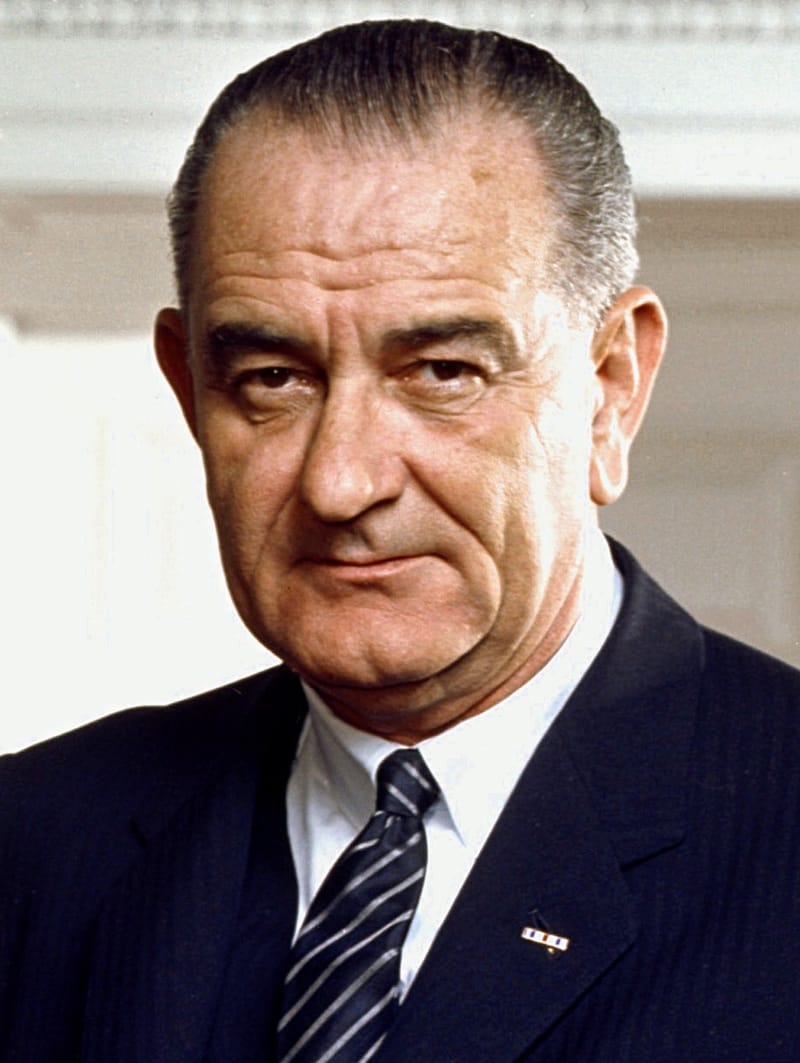
Lyndon Baines Johnson, the thirty-sixth president of the United States (1963–1969), was a Texas Hill Country schoolteacher who became one of the most skilled legislators in American history. Thrust into the presidency by John F. Kennedy’s assassination in November 1963, he pushed through the Civil Rights Act of 1964 and the Voting Rights Act of 1965, won a historic landslide, and launched the Great Society — Medicare, Medicaid, federal aid to education, and the War on Poverty. But his escalation of the Vietnam War tore the country apart, and in 1968 he declined to seek another term.
Key facts
- Born
- August 27, 1908, Texas Hill Country
- Died
- January 22, 1973
- Roles
- U.S. Representative from Texas (1937–1949); U.S. Senator and Senate Majority Leader; Vice President (1961–1963); Thirty-sixth president (1963–1969)
- Born
- August 27, 1908, in the Texas Hill Country
- Presidency
- November 22, 1963 – January 1969; Democrat
- 1964 election
- Won 61.1% of the popular vote against Barry Goldwater
- Domestic legacy
- Civil Rights and Voting Rights Acts, Medicare and Medicaid, War on Poverty, immigration reform
- Vietnam
- U.S. troops rose to almost 200,000 by the end of 1965 and more than 500,000 within three years
Why it matters
Johnson enacted the most sweeping domestic reforms since the New Deal, while his Vietnam policy tore the country apart.
Early life and context
Johnson was born on August 27, 1908, in a farmhouse on the Pedernales River, the first of five children; his father, a state legislator, rode up and down the river announcing that his son would be governor of Texas someday. Their house in Johnson City had neither electricity nor indoor plumbing. At twelve Lyndon told classmates he would one day be president. His father, a better politician than farmer, piled up debts and lost the family farm when Lyndon was a teenager; Johnson later said that at fourteen he resolved never to be the victim of a system that let cotton prices crash and ruin families like his own.
After high school he drifted — to California for odd jobs, then onto a Texas road crew, where he fell into drinking and fighting — before enrolling at Southwest Texas State Teachers College in 1927. Student-teaching at an impoverished Mexican American school in Cotulla, he pushed long-neglected children to take pride in their achievements. In 1931 he went to Washington as a congressional aide and was electrified by politics. In 1934 he met Claudia Alta Taylor, known as “Lady Bird,” and married her three months later.
Major actions and achievements
Appointed Texas director of the New Deal’s National Youth Administration in 1935, Johnson helped young people stay in school and find work. In 1937, at twenty-eight, he won a seat in Congress as a Roosevelt ally and brought electricity to the Hill Country of his youth — the achievement he called his proudest. He lost a 1941 Senate race in which both sides were accused of fraud, then won a Senate seat in 1948 by just 87 votes in a primary marred by suspicious tallies, earning the mocking nickname “Landslide Lyndon.” In the Senate he found his true calling: majority leader from 1955, he made the post one of the most powerful in government and passed the Civil Rights Act of 1957, the first in almost a century.
As Kennedy’s running mate in 1960, he helped carry the South. On November 22, 1963, riding two cars behind Kennedy in Dallas, he became president and was sworn in aboard Air Force One that afternoon. He won passage of Kennedy’s civil rights bill and tax cut and declared a War on Poverty. After defeating Barry Goldwater in a 1964 landslide, he won Medicare and Medicaid, federal aid to education, the Voting Rights Act, and a 1965 immigration law that abolished national-origin quotas — along with programs for urban renewal, environmental protection, consumer safety, and the arts and humanities.
Beliefs and ideas
Johnson believed the federal government could and should end poverty and racial injustice. A child of the New Deal who had seen his own family ruined by forces beyond its control, he saw government as an engine of opportunity, and in May 1964 he called for a Great Society that would end “poverty and racial injustice.” As vice president he had publicly backed Kennedy’s decision to send military advisers to South Vietnam to resist a communist insurgency.
Controversies, limits, and criticism
Johnson escalated the war in Vietnam without finding a strategy for victory, withdrawal, or peace with honor; American casualties mounted and the antiwar movement grew. By 1968 his approval rating had fallen below 30 percent. His road to power had been shadowed by the disputed 1948 primary. Critics on the right saw the Great Society as government overreach, and the reaction against it helped fuel a conservative countermovement.
Legacy
Johnson left office in January 1969 demoralized and discredited, and died at his Texas ranch on January 22, 1973, a few hundred feet from where he was born. His civil rights and social welfare programs kept many Americans out of poverty and secured the rights of citizenship for minorities. But Vietnam, where more than 58,000 Americans and millions of Southeast Asians died, clouded his legacy, and historians continue to debate how to weigh the two.
Study this entry
Check your understanding
Try answering in your own words, then open the answer.
1.What shaped Lyndon B. Johnson early in life?Show answerHide
Johnson was born on August 27, 1908, in a farmhouse on the Pedernales River, the first of five children; his father, a state legislator, rode up and down the river announcing that his son would be governor of Texas someday. Their house in Johnson City had neither electricity nor indoor plumbing.From “Early life and context” above.
2.What were Lyndon B. Johnson’s major achievements?Show answerHide
Appointed Texas director of the New Deal’s National Youth Administration in 1935, Johnson helped young people stay in school and find work. In 1937, at twenty-eight, he won a seat in Congress as a Roosevelt ally and brought electricity to the Hill Country of his youth — the achievement he called his proudest.From “Major actions and achievements” above.
3.What criticism or controversy surrounds Lyndon B. Johnson?Show answerHide
Johnson escalated the war in Vietnam without finding a strategy for victory, withdrawal, or peace with honor; American casualties mounted and the antiwar movement grew. By 1968 his approval rating had fallen below 30 percent.From “Controversies, limits, and criticism” above.
4.How is Lyndon B. Johnson remembered?Show answerHide
Johnson left office in January 1969 demoralized and discredited, and died at his Texas ranch on January 22, 1973, a few hundred feet from where he was born. His civil rights and social welfare programs kept many Americans out of poverty and secured the rights of citizenship for minorities.From “Legacy” above.
Turn this entry into 11 flashcards (key facts, dates, and why it matters) and review them in Learn.
Related History
How this connects to the rest of the atlas.
Events
People
Documents

Sources
- 1.Lyndon B. Johnson: Life in Brief
Miller Center, University of Virginia · Scholarly · cited for life and presidency
- 2.Lyndon B. Johnson: Life Before the Presidency
Miller Center, University of Virginia · Scholarly · cited for birth and early life
- 3.Lyndon B. Johnson: Impact and Legacy
Miller Center, University of Virginia · Scholarly · cited for legacy
- 4.The American Yawp, “The Sixties”
The American Yawp (eds. Joseph Locke and Ben Wright; Stanford University Press) · Scholarly · cited for civil rights, Great Society, Vietnam, social movements
- 5.Selma to Montgomery March
The Martin Luther King, Jr. Research and Education Institute, Stanford University · Scholarly · cited for Bloody Sunday, march, Voting Rights Act
Image credits
- 37 Lyndon Johnson 3x4, Arnold Newman, 1964-03-10. Via Wikimedia Commons · Public domain · Source
Written for American History Atlas from the sources above. See how entries are researched.
Atlas by Alexander. More on Telegram.