PersonThe Twenties and the Great Depression
Louis Armstrong
New Orleans trumpeter and singer who made jazz a soloist’s art and a world music
1901–1971
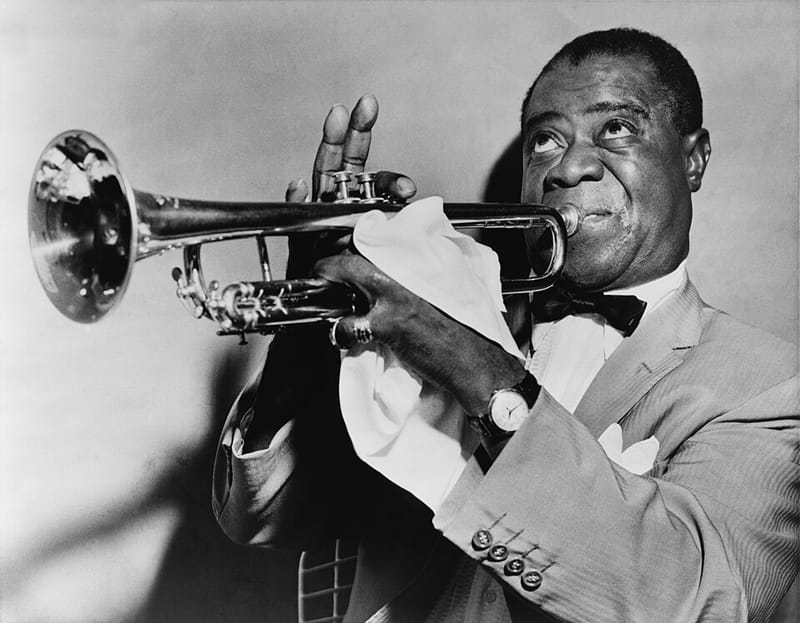
Louis Armstrong grew up poor in New Orleans, learned the cornet in a reform school, and followed his mentor Joe “King” Oliver to Chicago in 1922. His Hot Five and Hot Seven recordings of the 1920s put the improvising soloist at the center of jazz and popularized scat singing. Over a career of relentless touring, radio, and film — from “Heebie Jeebies” to “Hello, Dolly!” and “What a Wonderful World” — “Satchmo” became one of the most famous musicians in the world.
Key facts
- Born
- August 4, 1901, New Orleans, Louisiana
- Died
- July 6, 1971, Corona, Queens, New York
- Roles
- Cornetist and trumpeter; Singer and bandleader; Film performer; Unofficial goodwill ambassador abroad
- Nickname
- “Satchmo”; abroad, “Ambassador Satch”
- Breakthrough
- Hot Five and Hot Seven recordings, 1925–1928
- Signature records
- “Heebie Jeebies” (1926), “Hello, Dolly!” (1964), “What a Wonderful World” (1968)
- Firsts
- First African American to host a sponsored national radio broadcast (1937); first jazz musician on the cover of Time (1949)
- Birth date
- August 4, 1901 — though he often claimed July 4, 1900
Why it matters
Armstrong turned jazz into an art of individual improvisation and carried it around the world, making a music born in Black New Orleans one of America’s best-known cultural exports.
Early life and context
Armstrong was born on August 4, 1901, in New Orleans — though for most of his life he claimed July 4, 1900. Raised largely by his mother, Mary “Mayann” Albert, in a poor “back of town” neighborhood so rough it was nicknamed “The Battlefield,” he grew up surrounded by the music that was becoming jazz: blues, ragtime, brass-band marches, and spirituals. Not allowed inside the Funky Butt Hall, he watched the bands through cracks in its walls; delivering coal in the Storyville red-light district, he listened to some of the city’s best musicians. “We were poor and everything like that,” he recalled, “but music was all around you.”
He left school after fifth grade to work for the Karnofsky family, who encouraged his music, and he bought his first cornet with his wages. On New Year’s Eve 1912 he was arrested for firing a blank from his stepfather’s pistol and sent to the segregated Colored Waif’s Home for Boys, where teacher Peter Davis taught him to play properly and read music, and he became leader of the Home’s brass band. Released in 1914, he played at night while doing manual labor by day, then on Mississippi riverboats, where he learned to sight-read. The city’s top cornetist, Joe “King” Oliver, became his mentor, and at eighteen Armstrong was hired by trombonist Kid Ory to replace Oliver in Ory’s band.
Major actions and achievements
In 1922 Oliver sent for Armstrong to join his Creole Jazz Band in Chicago, where their intricate two-cornet breaks became the talk of the town; they began recording in 1923. Armstrong married the band’s pianist, Lil Hardin, in 1924, and she urged him to strike out on his own. After a year in New York with Fletcher Henderson’s orchestra, he returned to Chicago in 1925 and began recording under his own name. His Hot Five and Hot Seven records (1925–1928) — “Cornet Chop Suey,” “Potato Head Blues,” “West End Blues” — are often called the most influential in jazz. Instead of the band playing as one ensemble, Armstrong stepped out front for daring improvised solos, turning jazz into a soloist’s art. He did not invent scat singing, but his 1926 hit “Heebie Jeebies,” his first scat record, made it famous.
At the end of the decade he appeared on Broadway in the all-Black revue Hot Chocolates, and from then on he toured almost without stopping, eventually giving more than 300 performances a year for 30 years. In 1937 he became the first African American to host a sponsored national radio broadcast, and in 1949 the first jazz musician on the cover of Time. When big bands faded he formed a small group, the All Stars, in 1947. Abroad he was so popular that he was called “Ambassador Satch,” and the State Department sent him on tours to counter Soviet influence. In 1964 his recording of “Hello, Dolly!” knocked the Beatles off the top of the Billboard chart at the height of Beatlemania, making him the oldest artist with a number-one song. His last hit, “What a Wonderful World,” followed in 1968.
Beliefs and ideas
Armstrong built his art on reaching the widest possible audience; he toured relentlessly, playing, as the National Park Service puts it, “for anyone who would listen.” The Louis Armstrong House Museum calls him a great civil rights pioneer who broke down numerous barriers as a young man. In 1957, during the crisis over the integration of Central High School in Little Rock, Arkansas, he spoke out publicly against President Eisenhower’s handling of it.
Controversies, limits, and criticism
By the 1950s Armstrong’s gregarious, old-fashioned stage persona struck some modern jazz musicians and, later, Black Power advocates as out of date, and critics called him an “Uncle Tom.” His appearance as King of Zulu at the 1949 Mardi Gras, in the blackface makeup that was the Krewe of Zulu’s traditional, satirical attire, puzzled many fans who did not understand the custom. Admirers point out that he had broken many racial barriers as a young man and that he spoke out forcefully over Little Rock.
The touring took a heavy physical toll. Trumpet playing is brutal on the lips; Armstrong suffered lip damage most of his life, once had to stop performing for a year, and treated his scar tissue himself with salves and a razor blade. He had his first heart attack in 1959.
Legacy
After treatment for heart and kidney problems in 1968, doctors told Armstrong to stop playing, but he kept practicing every day at the modest house in Corona, Queens, that he and his fourth wife, Lucille, had shared since 1943. He returned to the stage in 1970 and died in his sleep on July 6, 1971, a few months after his last engagement. In the years after his death, a new generation led by the New Orleans trumpeter Wynton Marsalis championed his music. His Queens home was designated a National Landmark in 1976 and is now the Louis Armstrong House Museum. He is remembered as a pioneer who ushered in a new era of jazz and a leading figure of the Harlem Renaissance.
Study this entry
Check your understanding
Try answering in your own words, then open the answer.
1.What shaped Louis Armstrong early in life?Show answerHide
Armstrong was born on August 4, 1901, in New Orleans — though for most of his life he claimed July 4, 1900.From “Early life and context” above.
2.What were Louis Armstrong’s major achievements?Show answerHide
In 1922 Oliver sent for Armstrong to join his Creole Jazz Band in Chicago, where their intricate two-cornet breaks became the talk of the town; they began recording in 1923. Armstrong married the band’s pianist, Lil Hardin, in 1924, and she urged him to strike out on his own.From “Major actions and achievements” above.
3.What criticism or controversy surrounds Louis Armstrong?Show answerHide
By the 1950s Armstrong’s gregarious, old-fashioned stage persona struck some modern jazz musicians and, later, Black Power advocates as out of date, and critics called him an “Uncle Tom.”From “Controversies, limits, and criticism” above.
4.How is Louis Armstrong remembered?Show answerHide
After treatment for heart and kidney problems in 1968, doctors told Armstrong to stop playing, but he kept practicing every day at the modest house in Corona, Queens, that he and his fourth wife, Lucille, had shared since 1943.From “Legacy” above.
Turn this entry into 11 flashcards (key facts, dates, and why it matters) and review them in Learn.
Related History
How this connects to the rest of the atlas.

People
Movements

Sources
- 1.Louis Armstrong
National Park Service, New Orleans Jazz National Historical Park · Institutional · cited for life, Chicago and New York years, Hot Five, later career
- 2.Louis Armstrong: Harlem Renaissance Pioneer
National Archives, Pieces of History blog · Institutional · cited for birth date, youth, recordings, scat, firsts, State Department tours, legacy
- 3.Jazz Origins in New Orleans
National Park Service, New Orleans Jazz National Historical Park · Institutional · cited for origins of jazz, Armstrong’s role in the soloist’s art
- 4.Biography
Louis Armstrong House Museum · Institutional · cited for career from the Waif’s Home to the All Stars, Hot Chocolates, Little Rock, final years
- 5.Louis Armstrong
64 Parishes (Louisiana Endowment for the Humanities) · Reference · cited for childhood musical influences, Kid Ory, recordings, criticism, Zulu 1949, reputation
Image credits
- Louis Armstrong restored, World-Telegram staff photographer, 1953. Via Wikimedia Commons · Public domain · Source
Written for American History Atlas from the sources above. See how entries are researched.
Atlas by Alexander. More on Telegram.