PersonWorld War II and the Early Cold War
Elvis Presley
The “King of Rock & Roll,” who carried a blend of Black and white Southern music to a mass audience
1935–1977
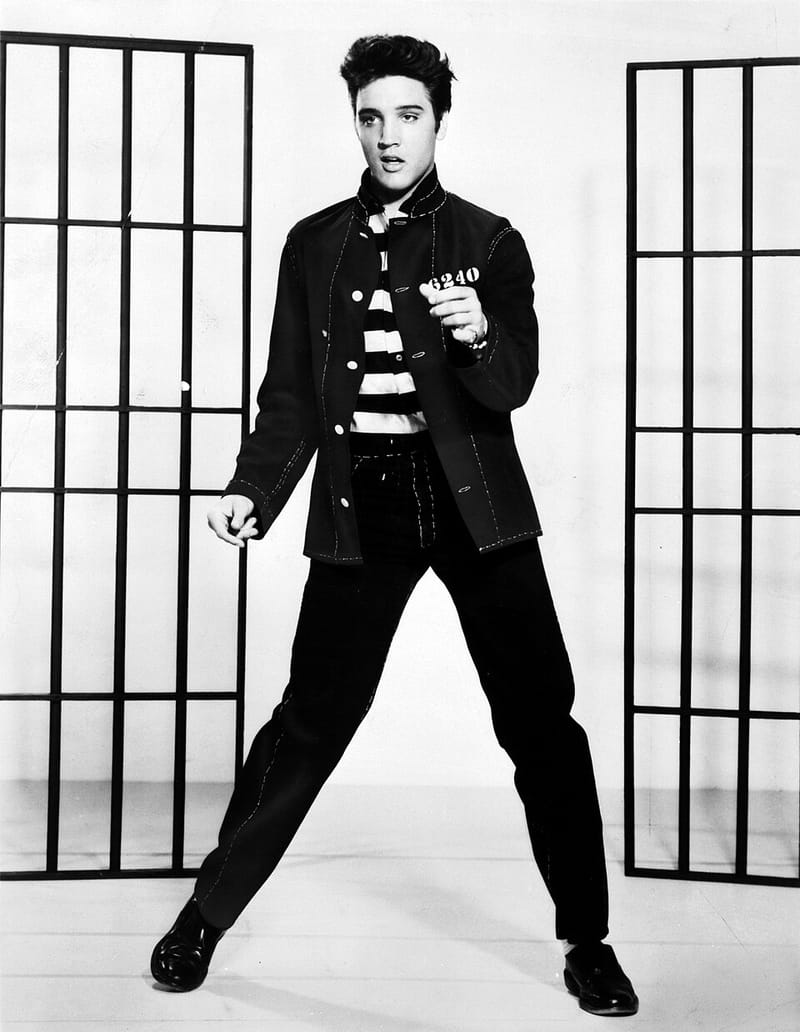
Elvis Presley, a young truck driver from Tupelo, Mississippi, began recording at a Memphis studio in the early 1950s and, in 1954, set off a musical and cultural revolution. Mixing blues, rhythm and blues, country, and gospel, he brought music rooted in Black traditions to huge white audiences, and his hip-shaking performances shocked parents as much as they thrilled teenagers. After a string of number-one hits, national television appearances, and movies, he served in the Army, spent the 1960s making films, and returned to the stage in 1969. He died at his Memphis home, Graceland, in 1977, at forty-two.
Key facts
- Born
- January 8, 1935, Tupelo, Mississippi
- Died
- August 16, 1977, Graceland, Memphis, Tennessee
- Roles
- Singer; Film actor; U.S. Army soldier (1958–1960)
- First single
- “That’s All Right” (1954), a blues song by Arthur Crudup, recorded for Sam Phillips’s Sun Records
- Breakthrough
- “Heartbreak Hotel” (1956), his first single for RCA Victor and his first number-one hit
- Army
- Drafted in 1958 at the height of his fame; served in Germany; honorably discharged in March 1960
- Movies
- First film, Love Me Tender (1956); for most of the 1960s he concentrated on making movies
- Hall of Fame
- Inducted into the Rock & Roll Hall of Fame in 1986
Why it matters
Presley was the figure through whom rock & roll exploded into mainstream culture. By bringing Black-influenced music to white audiences in the segregated 1950s, he helped remake American popular music and youth culture.
Early life and context
Elvis Aron Presley was born on January 8, 1935, in a two-room house in Tupelo, Mississippi, to Vernon and Gladys Presley. His twin brother, Jessie Garon, was stillborn, so Elvis grew up an only child. In 1948 the family moved to Memphis, where he graduated from Humes High School in 1953. As a teenager he belonged to a Pentecostal church and sometimes went to all-night gospel sings; he also absorbed the rhythm and blues he heard on Memphis’s Beale Street, as well as country and bluegrass. After high school he took a job driving a truck.
Major actions and achievements
In 1953 and 1954 Presley cut demo records at Sun Records, whose owner, Sam Phillips, had been looking for a white singer who could perform in the style of traditionally Black music. Phillips teamed him with guitarist Scotty Moore and bassist Bill Black, and during a sluggish 1954 session Elvis started goofing around with Arthur Crudup’s rhythm-and-blues song “That’s All Right.” Phillips recorded it and released it as Elvis’s first single. His five Sun singles blended rhythm and blues with country music into the sound later called rockabilly; his singing was so close to R&B that some Southern disc jockeys felt they had to tell listeners he was white. On the road, his gyrating hips caused an uproar and earned him the nickname “Elvis the Pelvis.”
Late in 1955 Phillips sold Presley’s contract to RCA Victor for $35,000, and Colonel Tom Parker became his manager. “Heartbreak Hotel” (1956) became his first number-one hit, and appearances on national television, including The Ed Sullivan Show, made him an overnight star. Hits like “Don’t Be Cruel” and “Hound Dog” — first recorded by Willie Mae “Big Mama” Thornton — followed, and in late 1956 he starred in his first film, Love Me Tender. Drafted into the Army in 1958 at the height of his fame, he had his pompadour cut and served in Friedberg, Germany, while records he had made earlier kept topping the charts.
Beliefs and ideas
Presley drew openly on the gospel, blues, and rhythm and blues he grew up with, and he moved easily between styles — from the edgy “hillbilly cat” of the Sun years to smooth balladeer, movie idol, and caped Las Vegas showman. He was also generous: a 1961 benefit concert he gave in Hawaii raised more than $65,000 toward the USS Arizona Memorial at Pearl Harbor.
Controversies, limits, and criticism
To many adults in the 1950s, Presley’s provocative stage moves were scandalous, and the controversy only fed his fame. His rise also raises questions about race in American music: Sam Phillips had gone looking for a white singer who could sound like Black musicians, and some of Presley’s biggest hits, like “Hound Dog,” had first been recorded by Black artists. After the Army, he gave up live concerts for nearly a decade to make two or three movies a year — films that were popular but never won the critical respect his music did.
Legacy
Presley returned to live performance in 1969 with a series of shows in Las Vegas and new hits such as “In the Ghetto” and “Suspicious Minds.” He died at Graceland, his Memphis home, on August 16, 1977, at forty-two. In 1986 he was inducted into the Rock & Roll Hall of Fame. “Without Elvis, there would be no Beatles,” said John Lennon, who recalled that when he first heard “Heartbreak Hotel,” his “whole life changed.” Graceland draws hundreds of thousands of visitors a year, and Presley remains, for much of the world, simply “the King.”
Study this entry
Check your understanding
Try answering in your own words, then open the answer.
1.What shaped Elvis Presley early in life?Show answerHide
Elvis Aron Presley was born on January 8, 1935, in a two-room house in Tupelo, Mississippi, to Vernon and Gladys Presley. His twin brother, Jessie Garon, was stillborn, so Elvis grew up an only child.From “Early life and context” above.
2.What were Elvis Presley’s major achievements?Show answerHide
In 1953 and 1954 Presley cut demo records at Sun Records, whose owner, Sam Phillips, had been looking for a white singer who could perform in the style of traditionally Black music.From “Major actions and achievements” above.
3.What criticism or controversy surrounds Elvis Presley?Show answerHide
To many adults in the 1950s, Presley’s provocative stage moves were scandalous, and the controversy only fed his fame.From “Controversies, limits, and criticism” above.
4.How is Elvis Presley remembered?Show answerHide
Presley returned to live performance in 1969 with a series of shows in Las Vegas and new hits such as “In the Ghetto” and “Suspicious Minds.” He died at Graceland, his Memphis home, on August 16, 1977, at forty-two.From “Legacy” above.
Turn this entry into 11 flashcards (key facts, dates, and why it matters) and review them in Learn.
Related History
How this connects to the rest of the atlas.
Movements

Sources
- 1.Elvis Presley
Rock & Roll Hall of Fame · Institutional · cited for significance, first recording, Army service, influence, Lennon quotation
- 2.Elvis Presley
Ohio State University, Arts and American Experience course materials · Reference · cited for childhood, Sun Records, RCA contract, television, films, death
Image credits
- Elvis Presley promoting Jailhouse Rock, Metro-Goldwyn-Mayer, 1957. Via Wikimedia Commons · Public domain · Source
Written for American History Atlas from the sources above. See how entries are researched.
Atlas by Alexander. More on Telegram.