ConceptThe Progressive Era and World War I
Jazz
America’s homegrown music, born in New Orleans
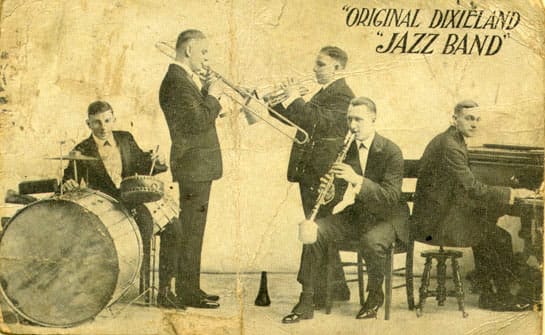
Jazz is an American musical style built on improvisation and syncopated rhythm. It grew out of New Orleans around 1900, where African, Caribbean, Creole, and European traditions, brass bands, ragtime, and the blues met. Popularized by the city’s African American community and spread by records and radio, it became a national sensation in the 1920s — the decade often called the Jazz Age — and then a music heard around the world.
Key facts
- Birthplace
- New Orleans, Louisiana
- Early innovator
- Cornetist Charles “Buddy” Bolden, 1895–1900
- Classic front line
- Cornet, clarinet, and trombone, improvising together
- First commercial recording
- 1917, by the Original Dixieland Jazz Band in New York
- Spread by
- Riverboats, touring shows, records, and radio
Why it matters
Jazz is one of the clearest examples of how African American culture shaped the whole nation’s — it gave the 1920s their name and became one of America’s best-known contributions to world music.
Definition
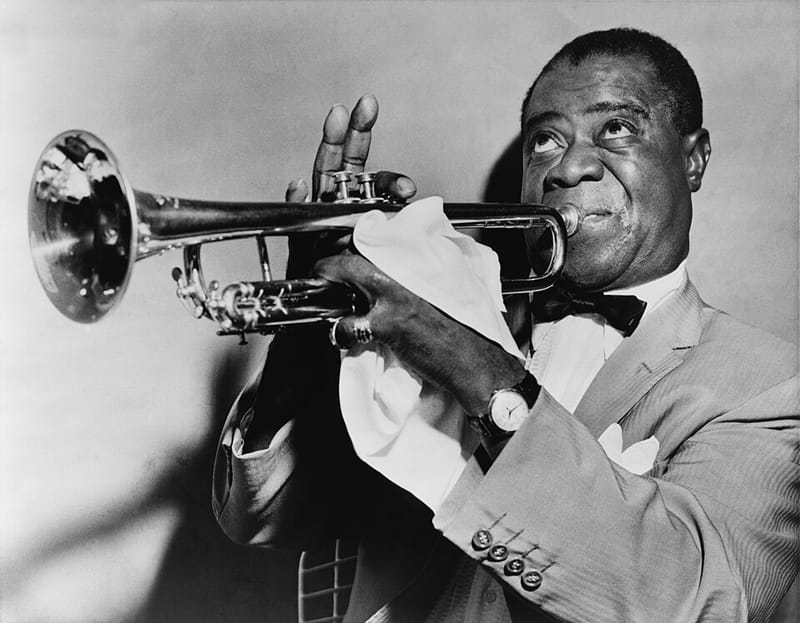
Jazz, in the words of The American Yawp, is “a uniquely American musical style” popularized by the African American community in New Orleans. Early New Orleans bands built it from collective improvisation: a front line of cornet, clarinet, and trombone “faking” ragtime together produced the music’s characteristic many-voiced sound. Later, players such as Louis Armstrong made the improvising soloist its center.
Historical context
New Orleans had a culture unlike the rest of the young United States: Catholic and French-speaking, fond of festivals and dancing, and shaped by Africans and people of African descent, who made up more than half the city’s population by the end of the 1700s. Enslaved people gathered on Sundays at what became known as Congo Square for African dances and drumming. After the Civil War, brass bands, ragtime, and blues filled the city’s parades, dances, and funerals.
Between 1895 and 1900 cornetist Buddy Bolden began mixing improvised blues into faster dance tunes. Segregation laws passed in the 1890s erased the special status of the city’s Creoles of color, which pushed Black and Creole musicians together and combined uptown improvisation with Creole training.
Examples
New Orleans musicians carried jazz north on riverboats and touring shows. In 1917 the Original Dixieland Jazz Band made the first commercial jazz recording, an unexpected hit, and jazz became a national craze; King Oliver’s Creole Jazz Band moved to Chicago, where Louis Armstrong joined it in 1922.
In the 1920s radio and records spread jazz everywhere. The New York Times ridiculed it as “savage” because of its racial heritage, but to others it represented cultural independence. In Harlem, white audiences flocked to the Cotton Club to hear stars like Duke Ellington — while the surrounding Black community was usually kept out.
Study this entry
Check your understanding
Try answering in your own words, then open the answer.
1.What does “Jazz” mean?Show answerHide
Jazz, in the words of The American Yawp, is “a uniquely American musical style” popularized by the African American community in New Orleans.From “Definition” above.
2.Where did the idea come from?Show answerHide
New Orleans had a culture unlike the rest of the young United States: Catholic and French-speaking, fond of festivals and dancing, and shaped by Africans and people of African descent, who made up more than half the city’s population by the end of the 1700s.From “Historical context” above.
3.What are some examples?Show answerHide
New Orleans musicians carried jazz north on riverboats and touring shows. In 1917 the Original Dixieland Jazz Band made the first commercial jazz recording, an unexpected hit, and jazz became a national craze; King Oliver’s Creole Jazz Band moved to Chicago, where Louis Armstrong joined it in 1922.From “Examples” above.
Turn this entry into 10 flashcards (key facts, dates, and why it matters) and review them in Learn.
Related History
How this connects to the rest of the atlas.
People

Sources
- 1.Jazz Origins in New Orleans
National Park Service, New Orleans Jazz National Historical Park · Institutional · cited for origins of jazz, Armstrong’s role in the soloist’s art
- 2.The American Yawp, “The New Era”
The American Yawp (eds. Joseph Locke and Ben Wright; Stanford University Press) · Scholarly · cited for the Jazz Age, radio and records, the Harlem Renaissance, the New Negro
- 3.Louis Armstrong
National Park Service, New Orleans Jazz National Historical Park · Institutional · cited for life, Chicago and New York years, Hot Five, later career
Image credits
- ODJBcard, Unknown author Unknown author, between 1917 and 1918. Via Wikimedia Commons · Public domain · Source
Written for American History Atlas from the sources above. See how entries are researched.
Atlas by Alexander. More on Telegram.