WarConservative Realignment and the End of the Cold War
Persian Gulf War
The U.S.-led coalition that expelled Iraq from Kuwait, 1990–1991
August 2, 1990 – February 28, 1991Kuwait, Iraq, and Saudi Arabia
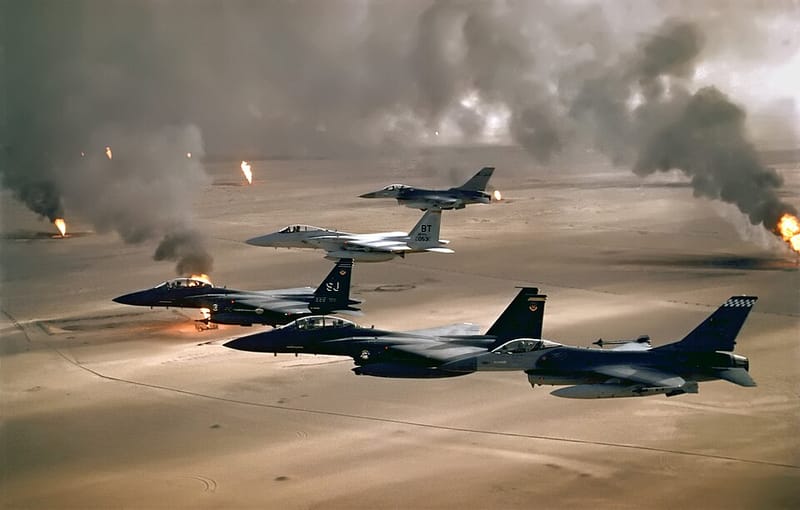
On August 2, 1990, Iraqi dictator Saddam Hussein invaded and annexed neighboring Kuwait. President George H. W. Bush organized a broad international coalition, backed by United Nations resolutions, and built up forces in Saudi Arabia (Operation Desert Shield). When Iraq refused to withdraw, the coalition launched an air war in January 1991 (Operation Desert Storm), followed by a ground offensive that drove Iraqi forces out of Kuwait in four days. The swift victory boosted Bush’s popularity and seemed to many to exorcise the “ghosts of Vietnam.”
Key facts
- Date
- August 2, 1990 – February 28, 1991
- Location
- Kuwait, Iraq, and Saudi Arabia
- Dating note
- Iraq invaded Kuwait August 2, 1990; the air war began January 16, 1991; the ground campaign began February 24 and ended February 28, 1991.
- Invasion
- August 2, 1990: some 100,000 Iraqi troops overran Kuwait
- UN authorization
- Resolution 678 authorized force if Iraq did not withdraw
- Air war
- Began January 1991
- Ground war
- February 24–28, 1991
- Outcome
- Kuwait liberated; Saddam Hussein remained in power
Why it matters
The Gulf War demonstrated American military dominance after the Cold War and began a long U.S. military involvement in the Persian Gulf.
Who fought
A U.S.-led coalition of many nations, acting under UN Security Council resolutions, fought Iraq under Saddam Hussein.
Political background
Iraq emerged from its 1980–1988 war with Iran deeply in debt, owing some $37 billion to Gulf creditors. Saddam Hussein demanded that Kuwait and the United Arab Emirates forgive Iraq’s loans, accused Kuwait of overproducing oil and stealing from a shared oil field, and revived old territorial claims.
Major phases
Invasion and Desert Shield (August 1990 – January 1991). Iraq overran Kuwait in hours and declared it Iraq’s nineteenth province. The UN Security Council demanded withdrawal and imposed sanctions; Resolution 678 authorized force if Iraq did not leave. Congress granted Bush authority to intervene, and the coalition massed forces in the region.
Desert Storm (January–February 1991). After the deadline passed, coalition air forces won control of the skies within a day and struck Iraqi command centers, infrastructure, and troops. Iraq fired missiles at Israel and Saudi Arabia, but Israel did not retaliate. Americans watched laser-guided bombs and round-the-clock coverage on cable news.
The ground war (February 24–28, 1991). A ground offensive routed Iraqi forces in about a hundred hours. The Iraqi military set fire to Kuwait’s oil fields, many of which burned for months.
Turning points
- UN Resolution 678: gave the coalition international legal authority.
- Air supremacy in the first days of Desert Storm: crippled Iraq’s ability to fight.
Outcome
Kuwait was liberated. Bush and his advisers decided not to march on Baghdad, fearing an occupation and insurgency, and Saddam Hussein stayed in power. The United States maintained sanctions, weapons inspections, and no-fly zones over Iraq for the next decade.
Consequences for American society
Bush’s approval rating reached 89 percent, though a recession helped defeat him in 1992. Continuing conflict with Saddam Hussein set the stage for the Iraq War of 2003.
Study this entry
Check your understanding
Try answering in your own words, then open the answer.
1.Why did the war begin?Show answerHide
Iraq emerged from its 1980–1988 war with Iran deeply in debt, owing some $37 billion to Gulf creditors. Saddam Hussein demanded that Kuwait and the United Arab Emirates forgive Iraq’s loans, accused Kuwait of overproducing oil and stealing from a shared oil field, and revived old territorial claims.From “Political background” above.
2.What were the turning points?Show answerHide
- UN Resolution 678: gave the coalition international legal authority. - Air supremacy in the first days of Desert Storm: crippled Iraq’s ability to fight.From “Turning points” above.
3.How did it end?Show answerHide
Kuwait was liberated. Bush and his advisers decided not to march on Baghdad, fearing an occupation and insurgency, and Saddam Hussein stayed in power.From “Outcome” above.
4.How did it change American society?Show answerHide
Bush’s approval rating reached 89 percent, though a recession helped defeat him in 1992. Continuing conflict with Saddam Hussein set the stage for the Iraq War of 2003.From “Consequences for American society” above.
Turn this entry into 11 flashcards (key facts, dates, and why it matters) and review them in Learn.
Related History
How this connects to the rest of the atlas.
Wars

Sources
- 1.The Gulf War, 1991
U.S. Department of State, Office of the Historian · Institutional · cited for causes, coalition, Desert Storm
- 2.The American Yawp, “The Recent Past”
The American Yawp (eds. Joseph Locke and Ben Wright; Stanford University Press) · Scholarly · cited for 1990s, 9/11, Afghanistan, Iraq, Great Recession, Obama, pandemic
Image credits
- USAF F-16A F-15C F-15E Desert Storm edit2, US Air Force. Via Wikimedia Commons · Public domain · Source
Written for American History Atlas from the sources above. See how entries are researched.
Atlas by Alexander. More on Telegram.