WarThe United States in the Twenty-First Century
Iraq War
The U.S. invasion and occupation of Iraq, 2003–2011
March 20, 2003 – December 18, 2011Iraq
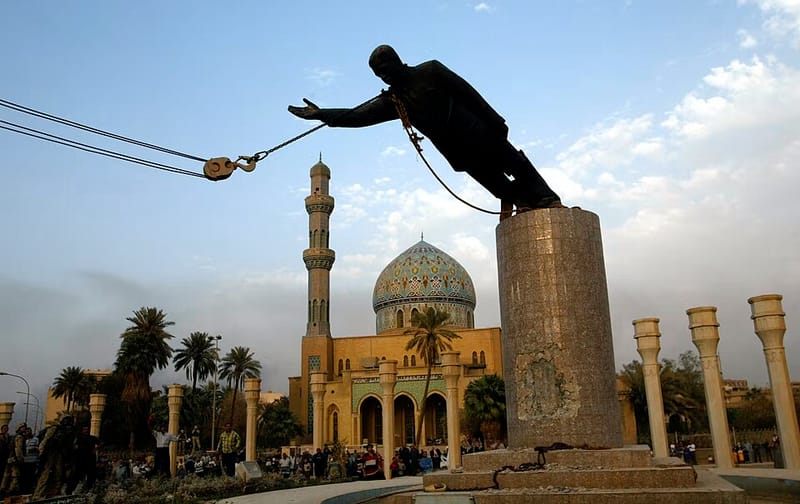
In March 2003, the United States led an invasion of Iraq to overthrow Saddam Hussein, whom the Bush administration accused of possessing weapons of mass destruction and linked to terrorism. Baghdad fell within weeks, but no weapons of mass destruction were ever found, and a long, bloody insurgency followed. A 2007 troop “surge” reduced violence, and the last U.S. combat forces left in December 2011. The war remains one of the most controversial in American history.
Key facts
- Date
- March 20, 2003 – December 18, 2011
- Location
- Iraq
- Dating note
- Bombing of Baghdad began March 20, 2003; the last U.S. combat forces left December 18, 2011.
- Congressional authorization
- October 2002
- Invasion
- Bombing of Baghdad began March 20, 2003; Baghdad fell April 9
- WMD
- None were found
- Saddam Hussein
- Captured December 13, 2003; executed December 30, 2006
- U.S. withdrawal
- Last combat forces left December 18, 2011
Why it matters
The Iraq War became a cautionary tale about preventive war, faulty intelligence, and the difficulty of occupation.
Who fought
A U.S.-led coalition fought Saddam Hussein’s regime and then a range of insurgents, including al-Qaeda in Iraq.
Political background
After the 1991 Gulf War, the United States maintained sanctions, weapons inspections, and no-fly zones over Iraq. In 1998 President Clinton ordered strikes on suspected weapons sites. After 9/11, Bush administration officials championed “regime change,” claiming Iraq had weapons of mass destruction; Bush declared there was “no doubt” of it.
Major phases
Invasion (2003). Congress authorized force in October 2002. Although Iraq began cooperating with UN inspectors, the administration pressed on, and Secretary of State Colin Powell presented allegations of an Iraqi weapons program to the UN in February 2003. Protests broke out worldwide. The first bombs fell on Baghdad on March 20, 2003; the regime collapsed and Baghdad fell on April 9. On May 1, beneath a “Mission Accomplished” banner, Bush announced that major combat operations had ended.
Insurgency (2003–2006). No weapons of mass destruction were found. An insurgency grew; revelations of prisoner abuse at Abu Ghraib damaged the U.S. cause, and groups such as al-Qaeda in Iraq bombed civilians. Saddam Hussein was captured in December 2003 and executed in 2006.
Surge and withdrawal (2007–2011). In 2007, 27,000 additional U.S. troops under General David Petraeus used new counterinsurgency strategies, and with Sunni cooperation pacified many cities. After Iraq’s government approved a U.S.-Iraq Status of Forces Agreement in December 2008, U.S. combat forces withdrew from Iraqi cities by June 30, 2009, and the last combat forces left the country on December 18, 2011.
Turning points
- The fall of Baghdad (April 2003): a quick conventional victory that gave way to occupation.
- The failure to find WMD: undermined the war’s justification.
- The surge (2007): reduced violence and enabled withdrawal.
Outcome
Saddam Hussein’s regime was destroyed, but violence and instability continued after American forces left.
Consequences for American society
The war deepened distrust of government claims, and became a central issue in the 2004 and 2008 elections; Barack Obama’s early opposition to it helped him win the presidency.
Study this entry
Check your understanding
Try answering in your own words, then open the answer.
1.Why did the war begin?Show answerHide
After the 1991 Gulf War, the United States maintained sanctions, weapons inspections, and no-fly zones over Iraq. In 1998 President Clinton ordered strikes on suspected weapons sites.From “Political background” above.
2.What were the turning points?Show answerHide
- The fall of Baghdad (April 2003): a quick conventional victory that gave way to occupation. - The failure to find WMD: undermined the war’s justification. - The surge (2007): reduced violence and enabled withdrawal.From “Turning points” above.
3.How did it end?Show answerHide
Saddam Hussein’s regime was destroyed, but violence and instability continued after American forces left.From “Outcome” above.
4.How did it change American society?Show answerHide
The war deepened distrust of government claims, and became a central issue in the 2004 and 2008 elections; Barack Obama’s early opposition to it helped him win the presidency.From “Consequences for American society” above.
Turn this entry into 10 flashcards (key facts, dates, and why it matters) and review them in Learn.
Related History
How this connects to the rest of the atlas.
Wars


Sources
- 1.The American Yawp, “The Recent Past”
The American Yawp (eds. Joseph Locke and Ben Wright; Stanford University Press) · Scholarly · cited for 1990s, 9/11, Afghanistan, Iraq, Great Recession, Obama, pandemic
- 2.George W. Bush: Life in Brief
Miller Center, University of Virginia · Scholarly · cited for Bush presidency, 9/11, wars
- 3.The Gulf War, 1991
U.S. Department of State, Office of the Historian · Institutional · cited for causes, coalition, Desert Storm
Image credits
- SaddamStatue, Unknown U.S. military or Department of Defense employee, 2003-04-09. Via Wikimedia Commons · Public domain · Source
Written for American History Atlas from the sources above. See how entries are researched.
Atlas by Alexander. More on Telegram.