EventCivil Rights and Social Transformation
Woodstock
“3 Days of Peace and Music” that came to define a generation
August 1969Bethel, New York
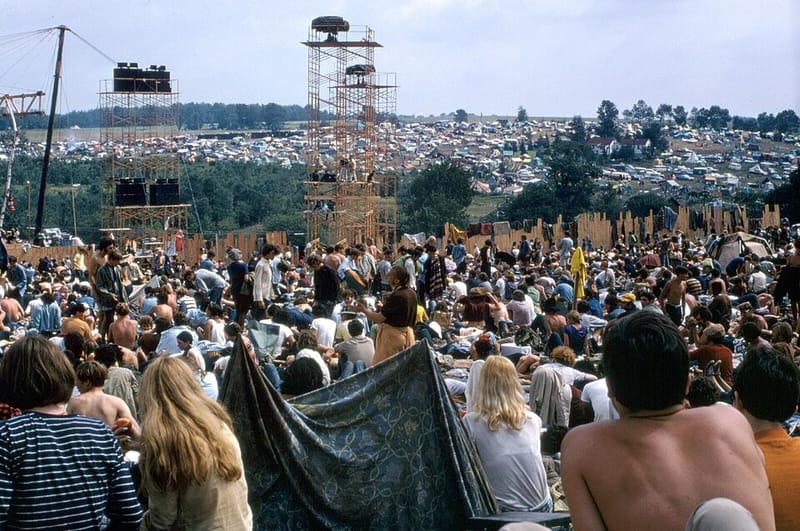
In August 1969 nearly half a million young people gathered on Yasgur’s farm near Bethel, New York, for a music festival billed as “An Aquarian Exposition: 3 Days of Peace and Music.” Rain, mud, and shortages turned the weekend into an improvised city — and, for many, a demonstration of the counterculture’s ideals of peace and cooperation. Coming weeks after the Moon landing and amid conflict over the Vietnam War, civil rights, and sexual politics, Woodstock became shorthand for the youth culture of the 1960s.
Key facts
- Date
- August 1969
- Location
- Bethel, New York
- When
- Three days in August 1969
- Where
- Yasgur’s farm, Bethel, New York
- Crowd
- Nearly half a million people
- Billed as
- “An Aquarian Exposition: 3 Days of Peace and Music”
Why it matters
Woodstock is remembered as the high point of the 1960s counterculture — a symbol of a generation that challenged the values of its parents.
Historical background
In the 1960s protests across the country formed the backdrop for an American counterculture. Rebellion against the supposedly hidebound conservatism of the 1950s spread among the young, and the counterculture — with its music, its experiments with psychedelic drugs, and its search for personal fulfillment — increasingly reached the mainstream through popular culture and even advertising.
Causes and contributing factors
The festival took place weeks after Americans first walked on the Moon, against the backdrop of a nation divided over the Vietnam War, civil rights, and sexual politics. PBS describes a sense of an America in transition — a handoff between generations with very different values and ideals.
What happened
Over three days, a crowd of nearly half a million — rain-soaked, often hungry, many of them on drugs — turned a few acres of farmland into a swarming, impromptu city. PBS’s American Experience calls what happened “nothing less than a miracle of teamwork,” a demonstration of the “peace and love” the festival had promised.
Immediate consequences
To many participants and observers the weekend seemed to validate the counterculture’s promise. The festival quickly became a legend in its own right.
Long-term significance
The American Yawp calls 1969’s Woodstock concert “shorthand for the new youth culture and its mixture of politics, protest, and personal fulfillment.” The hippies’ rise was exaggerated and short-lived, and the Vietnam War and Richard Nixon shattered much of its idealism — but the counterculture’s liberated social norms and its embrace of personal fulfillment still shape much of American culture.
Study this entry
Check your understanding
Try answering in your own words, then open the answer.
1.What led to Woodstock?Show answerHide
The festival took place weeks after Americans first walked on the Moon, against the backdrop of a nation divided over the Vietnam War, civil rights, and sexual politics. PBS describes a sense of an America in transition — a handoff between generations with very different values and ideals.From “Causes and contributing factors” above.
2.What happened?Show answerHide
Over three days, a crowd of nearly half a million — rain-soaked, often hungry, many of them on drugs — turned a few acres of farmland into a swarming, impromptu city. PBS’s American Experience calls what happened “nothing less than a miracle of teamwork,” a demonstration of the “peace and love” the festival had promised.From “What happened” above.
3.What were the immediate consequences?Show answerHide
To many participants and observers the weekend seemed to validate the counterculture’s promise. The festival quickly became a legend in its own right.From “Immediate consequences” above.
4.Why does it still matter?Show answerHide
The American Yawp calls 1969’s Woodstock concert “shorthand for the new youth culture and its mixture of politics, protest, and personal fulfillment.”From “Long-term significance” above.
Turn this entry into 10 flashcards (key facts, dates, and why it matters) and review them in Learn.
Related History
How this connects to the rest of the atlas.

Sources
- 1.Woodstock (American Experience)
PBS, American Experience · Reference · cited for the festival, crowd, setting, and meaning
- 2.The American Yawp, “The Sixties”
The American Yawp (eds. Joseph Locke and Ben Wright; Stanford University Press) · Scholarly · cited for the counterculture and Woodstock’s place in it
Image credits
- Blanket tent and the crowd awaits, James M Shelley, Taken on 17 August 1969. Via Wikimedia Commons · CC BY-SA 4.0 · Source
Written for American History Atlas from the sources above. See how entries are researched.
Atlas by Alexander. More on Telegram.