PersonIndustrialization and the Gilded Age
Thomas Edison
Inventor of the phonograph and a practical electric light, and creator of the modern research laboratory
1847–1931
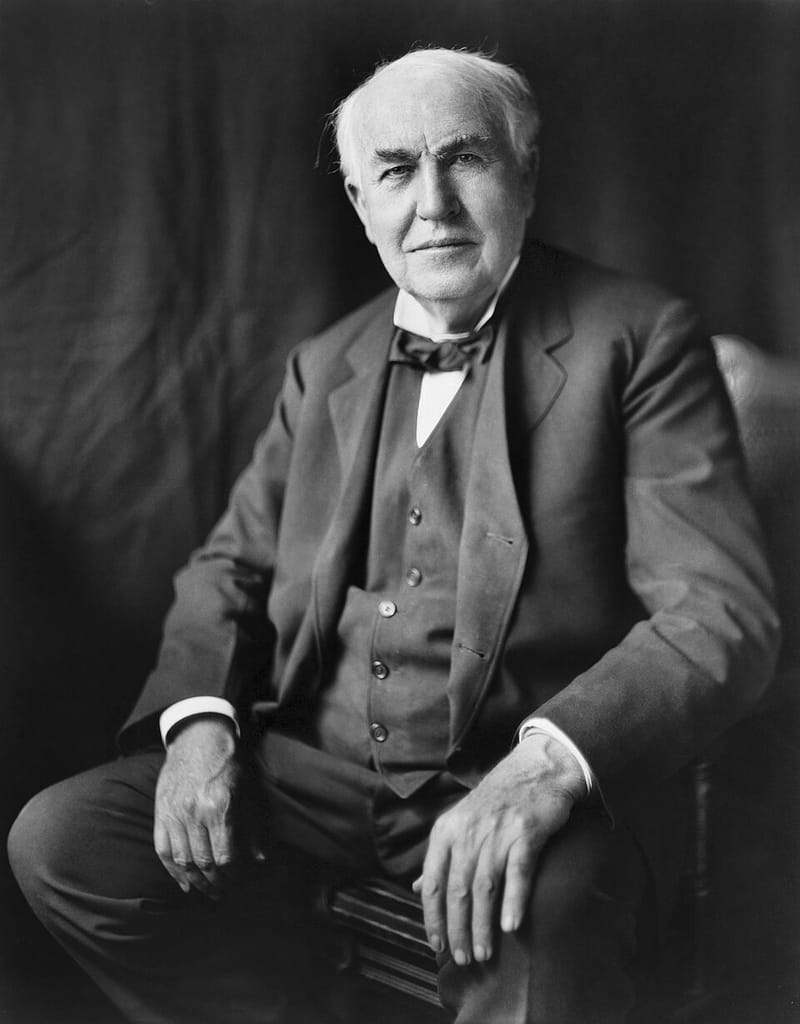
Thomas Edison, a boy with only a few months of schooling who sold newspapers on a Michigan railroad, became one of the most celebrated inventors in American history. At his Menlo Park, New Jersey, laboratory — the first industrial research lab — he invented the phonograph in 1877 and developed a practical electric light and the whole system needed to power it; in 1882 his Pearl Street station began lighting lower Manhattan. Later, at West Orange, he helped create the recording and motion picture industries. To his countrymen he became a living symbol of American ingenuity.
Key facts
- Born
- February 11, 1847, Milan, Ohio
- Died
- October 18, 1931, West Orange, New Jersey
- Roles
- Telegrapher; Inventor; Industrialist; Head of the Naval Consulting Board (World War I)
- Phonograph
- 1877: the first machine that could record and play back sound
- Electric light
- A carbonized-thread filament burned for 13½ hours; Menlo Park was lit up in December 1879
- Power station
- Pearl Street, lower Manhattan, opened in September 1882 — “the electric age had begun”
- Laboratories
- Menlo Park (1876), the first of its kind; West Orange (1887), where up to 10,000 people worked during World War I
- Honors
- A special Congressional medal in 1928
Why it matters
Edison did not just invent devices; he built complete systems — power plants, wiring, records, film studios — that turned inventions into industries, and his research laboratory became the model for modern corporate science. Electric light, recorded sound, and movies reshaped everyday American life.
Early life and context
Thomas Alva Edison was born on February 11, 1847, in Milan, Ohio, the seventh and last child of Samuel and Nancy Edison; when he was seven the family moved to Port Huron, Michigan. He attended school for only a few months. His mother taught him reading, writing, and arithmetic, and he taught himself the rest from books. At thirteen he went to work selling newspapers and candy on the railroad between Port Huron and Detroit, reading scientific books in his spare time and learning to operate a telegraph. By sixteen he was a full-time telegrapher, drifting from city to city in a booming industry.
In Boston in 1868 he began to turn from telegrapher to inventor. His first patent, an electric vote recorder for legislatures, was a commercial failure, and he resolved to invent only things the public would want. In New York his improved stock ticker earned him $40,000 — enough to open his first laboratory and factory in Newark, New Jersey, in 1871. There he improved the telegraph and married Mary Stilwell.
Major actions and achievements
In 1876 Edison moved to the village of Menlo Park, New Jersey, and built a laboratory equipped to work on any invention — the first research and development lab anywhere, sometimes called his greatest invention. His first great success there was the tinfoil phonograph of 1877, the first machine that could record and reproduce sound. It made him world famous; he demonstrated it at the White House for President Rutherford B. Hayes in 1878. So great was his fame that when a New York paper ran a fake April Fool’s interview describing an Edison machine that made food out of air, water, and dirt, readers wrote asking when it would be on sale.
Next he took on electric light. The idea was not new, but no one had made it practical for the home. After a year and a half, a lamp with a filament of carbonized sewing thread burned for thirteen and a half hours, and in December 1879 Edison lit up the Menlo Park complex. He then built everything else an electric system needed, and in September 1882 his Pearl Street power station began supplying a square mile of lower Manhattan. His electric companies later merged into what became General Electric.
In 1887 he opened a much larger laboratory in West Orange, New Jersey, where he could run ten or twenty projects at once. There he turned the phonograph into a home product, creating the recording industry, and developed a device to do “for the eye what the phonograph does for the ear”: motion pictures, first shown in 1891 and filmed from 1893 in a studio called the Black Maria. After ten years of work he produced an alkaline storage battery that became his most profitable product.
Beliefs and ideas
Edison believed in self-improvement, practical results, and relentless work. After his first patent failed, he insisted on inventing only what people would buy, and he approached each problem by developing the whole system it needed. He favored military preparedness before World War I and headed the Navy’s board of civilian inventors.
Controversies, limits, and criticism
Edison’s greatest failure was a decade-long attempt in the 1890s to mine iron ore in New Jersey with new methods; he sold all his General Electric stock to pay for it and lost everything he put in. He never controlled the company that bore his name — bankers such as J. P. Morgan financed the electric industry, and in 1892 “Edison” was dropped from General Electric’s name. In motion pictures, many others soon improved on his early work, and by 1918 competition drove him out of the business. His achievements also depended on staffs of skilled assistants and on capital from investment bankers.
Legacy
In later life Edison became a cultural icon, a real-life Horatio Alger hero. Congress voted him a special medal in 1928, and in 1929, for the fiftieth anniversary of the electric light, Henry Ford gave a banquet in his honor at Greenfield Village, where Ford had restored the Menlo Park laboratory; President Herbert Hoover attended. At Ford’s and Harvey Firestone’s request, Edison spent his last years testing thousands of plants as an American source of rubber, settling on goldenrod. He died at his home, Glenmont, in West Orange on October 18, 1931. His laboratory and home are now Thomas Edison National Historical Park.
Study this entry
Check your understanding
Try answering in your own words, then open the answer.
1.What shaped Thomas Edison early in life?Show answerHide
Thomas Alva Edison was born on February 11, 1847, in Milan, Ohio, the seventh and last child of Samuel and Nancy Edison; when he was seven the family moved to Port Huron, Michigan. He attended school for only a few months.From “Early life and context” above.
2.What were Thomas Edison’s major achievements?Show answerHide
In 1876 Edison moved to the village of Menlo Park, New Jersey, and built a laboratory equipped to work on any invention — the first research and development lab anywhere, sometimes called his greatest invention.From “Major actions and achievements” above.
3.What criticism or controversy surrounds Thomas Edison?Show answerHide
Edison’s greatest failure was a decade-long attempt in the 1890s to mine iron ore in New Jersey with new methods; he sold all his General Electric stock to pay for it and lost everything he put in.From “Controversies, limits, and criticism” above.
4.How is Thomas Edison remembered?Show answerHide
In later life Edison became a cultural icon, a real-life Horatio Alger hero.From “Legacy” above.
Turn this entry into 11 flashcards (key facts, dates, and why it matters) and review them in Learn.
Related History
How this connects to the rest of the atlas.
Events
People

Sources
- 1.Edison Biography
National Park Service, Thomas Edison National Historical Park · Institutional · cited for life, laboratories, phonograph, electric light, Pearl Street, movies, battery, failures, honors, death
- 2.Thomas Edison National Historical Park
National Park Service · Institutional · cited for park
- 3.18. Industrial America
The American Yawp (Stanford University Press) · Scholarly · cited for 1878 April Fool’s food machine story; electric power research
Image credits
- Thomas Alva Edison, Louis Bachrach, Bachrach Studios, circa 1922. Via Wikimedia Commons · Public domain · Source
Written for American History Atlas from the sources above. See how entries are researched.
Atlas by Alexander. More on Telegram.