ConceptConservative Realignment and the End of the Cold War
The Digital Revolution
Computers, the internet, and smartphones transform American life
1969–present
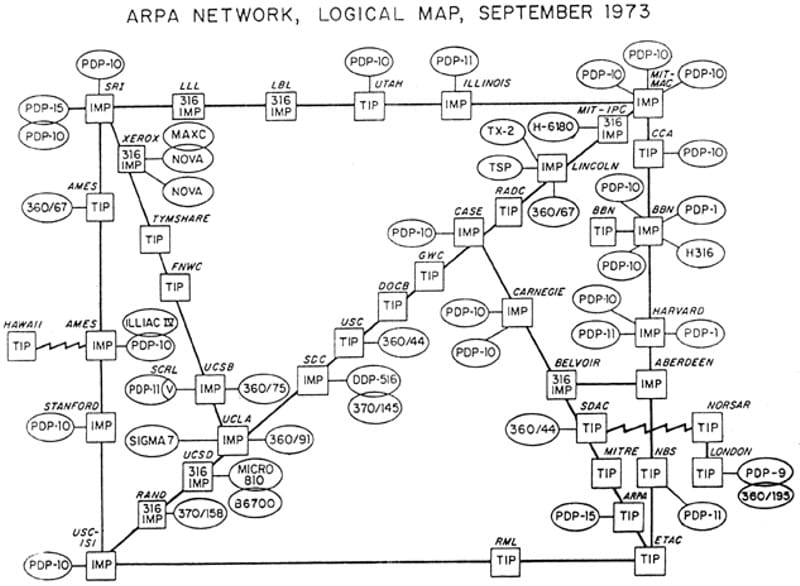
The digital revolution is the transformation of the economy and daily life by computers and networked communication. Its roots lie in government-funded research: the Defense Department’s ARPANET began with four computers in 1969, and the National Science Foundation’s NSFNET, launched in 1986, became the backbone of the early internet. In the 1990s personal computers and the web turned the internet into a mass phenomenon and fueled the dot-com boom; after 2007, smartphones and social media put the internet in Americans’ pockets.
Key facts
- Date
- 1969–present
- ARPANET
- Began with four computer nodes in late 1969
- NSFNET
- Launched 1986; grew from about 2,000 connected computers to more than 2 million by 1993
- Mosaic
- First freely available web browser, developed with NSF support at the University of Illinois
- Commercial internet
- NSF retired the NSFNET backbone in 1995 as commercial services took over
- Smartphones
- The iPhone (2007) popularized smartphones; about two-thirds of Americans owned one by about 2015
Why it matters
The digital revolution remade how Americans work, shop, learn, communicate, and get their news — and created new questions about privacy, misinformation, and economic inequality.
Definition
The term describes the shift, beginning in the late twentieth century, from industrial and analog technologies to digital computing and communications — and the economic, social, and political changes that followed.
Historical context
In the early 1960s J. C. R. Licklider imagined an “Intergalactic Computer Network.” Defense Department researchers built ARPANET and developed the TCP/IP protocols that let computers exchange email and files. NSFNET connected academic researchers nationwide, and as commercial firms built their own networks, NSF shut down its backbone in 1995. In the 1990s, personal computer sales skyrocketed, the Mosaic browser made the web graphical, and investors poured money into internet companies. The dot-com bubble burst at the start of the new century. The release of the iPhone in 2007 and the rise of social media made mobile, always-on connection part of everyday life.
Examples
- The dot-com boom (1990s): investors scrambled to find the next Microsoft, Apple, Google, or Amazon.
- Smartphones: about a third of Americans owned a mobile computing device by 2011, and two-thirds four years later.
- Social media: Americans increasingly turned to social networks, rather than newspapers and magazines, for news and information.
Study this entry
Check your understanding
Try answering in your own words, then open the answer.
1.What does “the Digital Revolution” mean?Show answerHide
The term describes the shift, beginning in the late twentieth century, from industrial and analog technologies to digital computing and communications — and the economic, social, and political changes that followed.From “Definition” above.
2.Where did the idea come from?Show answerHide
In the early 1960s J. C. R. Licklider imagined an “Intergalactic Computer Network.” Defense Department researchers built ARPANET and developed the TCP/IP protocols that let computers exchange email and files.From “Historical context” above.
3.What are some examples?Show answerHide
- The dot-com boom (1990s): investors scrambled to find the next Microsoft, Apple, Google, or Amazon. - Smartphones: about a third of Americans owned a mobile computing device by 2011, and two-thirds four years later. - Social media: Americans increasingly turned to social networks, rather than newspapers and magazines, for news and information.From “Examples” above.
Turn this entry into 11 flashcards (key facts, dates, and why it matters) and review them in Learn.
Related History
How this connects to the rest of the atlas.
Events




Sources
- 1.Birth of the Commercial Internet
U.S. National Science Foundation · Institutional · cited for ARPANET, NSFNET, Mosaic, commercialization
- 2.The American Yawp, “The Recent Past”
The American Yawp (eds. Joseph Locke and Ben Wright; Stanford University Press) · Scholarly · cited for 1990s, 9/11, Afghanistan, Iraq, Great Recession, Obama, pandemic
Image credits
- ARPA Network, Logical Map, September 1973, Bolt Beranek and Newman Inc., 1973-09. Via Wikimedia Commons · Public domain · Source
Written for American History Atlas from the sources above. See how entries are researched.
Atlas by Alexander. More on Telegram.