EventThe Twenties and the Great Depression
Stock Market Crash of 1929
The collapse that ended the Roaring Twenties boom
October 24–29, 1929New York Stock Exchange, New York City
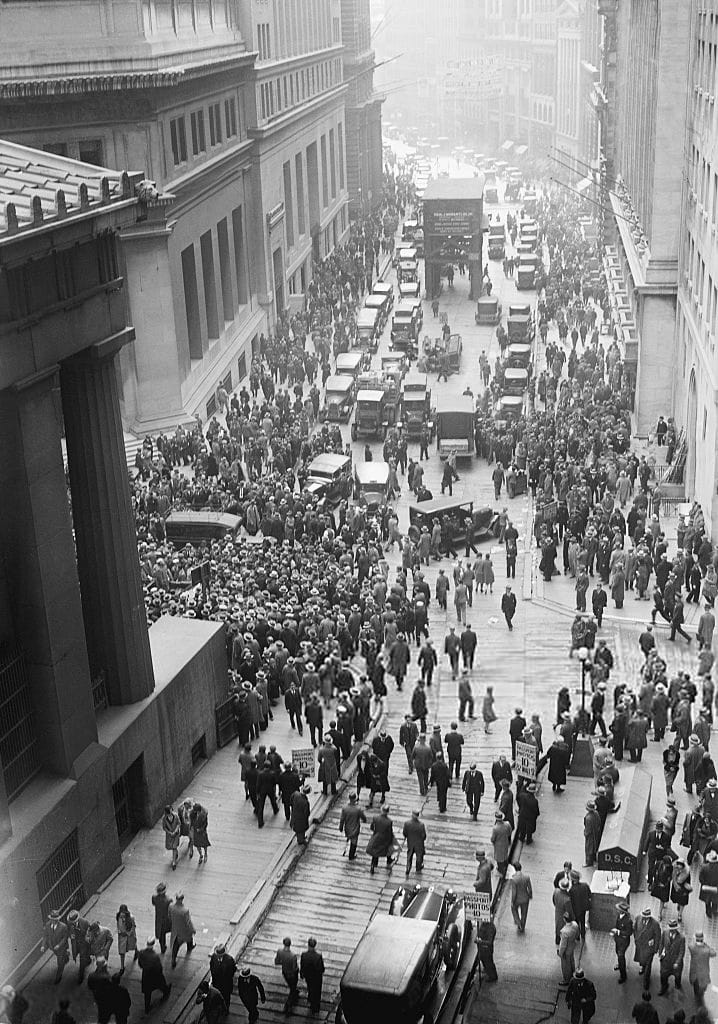
In October 1929 the great stock market boom of the 1920s collapsed. After panic selling on “Black Thursday,” October 24, the Dow Jones Industrial Average fell nearly 13 percent on Black Monday, October 28, and nearly 12 percent more on Black Tuesday, October 29. The slide continued until 1932, when stocks had lost 89 percent of their peak value. The crash did not by itself cause the Great Depression, but it frightened investors and consumers and exposed deep weaknesses in the economy.
Key facts
- Date
- October 24–29, 1929
- Location
- New York Stock Exchange, New York City
- Dating note
- Panic selling began on Black Thursday, October 24; the steepest losses came on Black Monday and Black Tuesday, October 28–29. Prices kept sliding until July 1932.
- Peak
- Dow closed at 381.17 on September 3, 1929
- Black Monday
- October 28, 1929: down nearly 13%
- Black Tuesday
- October 29, 1929: down nearly 12%
- Bottom
- 41.22 on July 8, 1932 — 89% below the peak
- Recovery
- The Dow did not regain its 1929 high until November 23, 1954
Why it matters
The Crash of 1929 became the symbolic beginning of the Great Depression and a lasting warning about speculation and borrowed money.
Historical background
The Dow Jones Industrial Average rose sixfold, from 63 in August 1921 to 381 in September 1929. New brokerage houses, investment trusts, and margin accounts let ordinary people buy stocks with borrowed money, typically putting down 10 percent of the price and borrowing the rest. Even so, only about 2.5 percent of Americans had brokerage accounts. In mid-October 1929 the economist Irving Fisher declared that stock prices had reached “what looks like a permanently high plateau.”
Causes and contributing factors
Federal Reserve officials believed speculation was diverting credit from productive uses. The Board urged reserve banks to deny credit to member banks that lent to speculators, and in August 1929 it allowed the New York Fed to raise its discount rate to 6 percent. Lending to brokers continued anyway. Meanwhile the economy had already begun contracting in the summer of 1929.
What happened
Prices peaked on September 3, 1929. As they fell in October, leading bankers met at the offices of J. P. Morgan, pooled funds, and publicly bought blocks of shares at high prices to restore confidence. The market steadied briefly, but on Black Monday and Black Tuesday frightened investors dumped their holdings. Shares of U.S. Steel eventually fell from $262 to $22, and General Motors from $73 to $8.
Immediate consequences
The crash wiped out savings and confidence. Fearful consumers stopped buying big-ticket items on credit, such as automobiles; firms like Ford cut production and laid off workers, and the downturn deepened. According to the Federal Reserve’s historians, the crash’s direct impact faded within months, and by the fall of 1930 recovery seemed possible — until waves of bank failures turned a sharp recession into the longest and deepest depression in the nation’s history.
Long-term significance
Economists drew lessons from 1929: that central banks should be cautious about trying to deflate stock market bubbles, and that the damage from a crash can be contained if the financial system is protected. The crash led to new securities regulation in the New Deal, and it remains the reference point for every later market panic.
Study this entry
Check your understanding
Try answering in your own words, then open the answer.
1.What led to Stock Market Crash of 1929?Show answerHide
Federal Reserve officials believed speculation was diverting credit from productive uses. The Board urged reserve banks to deny credit to member banks that lent to speculators, and in August 1929 it allowed the New York Fed to raise its discount rate to 6 percent.From “Causes and contributing factors” above.
2.What happened?Show answerHide
Prices peaked on September 3, 1929. As they fell in October, leading bankers met at the offices of J. P. Morgan, pooled funds, and publicly bought blocks of shares at high prices to restore confidence.From “What happened” above.
3.What were the immediate consequences?Show answerHide
The crash wiped out savings and confidence. Fearful consumers stopped buying big-ticket items on credit, such as automobiles; firms like Ford cut production and laid off workers, and the downturn deepened.From “Immediate consequences” above.
4.Why does it still matter?Show answerHide
Economists drew lessons from 1929: that central banks should be cautious about trying to deflate stock market bubbles, and that the damage from a crash can be contained if the financial system is protected.From “Long-term significance” above.
Turn this entry into 11 flashcards (key facts, dates, and why it matters) and review them in Learn.
Related History
How this connects to the rest of the atlas.


Sources
- 1.Stock Market Crash of 1929
Federal Reserve History (Federal Reserve System) · Institutional · cited for Dow figures, dates, margin buying, Fed policy
- 2.The Great Depression
Federal Reserve History (Federal Reserve System) · Institutional · cited for dates, banking panics, money supply, Fed mistakes
- 3.Great Depression Facts
Franklin D. Roosevelt Presidential Library and Museum (National Archives) · Institutional · cited for statistics
- 4.The American Yawp, “The Great Depression”
The American Yawp (eds. Joseph Locke and Ben Wright; Stanford University Press) · Scholarly · cited for crash, Depression, New Deal, Dust Bowl
Image credits
- Crowd outside nyse, US-gov, Taken on 29 October 1929. Via Wikimedia Commons · Public domain · Source
Written for American History Atlas from the sources above. See how entries are researched.
Atlas by Alexander. More on Telegram.