EventThe Twenties and the Great Depression
The Dust Bowl
Drought, dust storms, and migration on the southern Plains in the 1930s
c. 1930–1940Southern Great Plains: western Kansas, southeastern Colorado, the Oklahoma Panhandle, the Texas Panhandle, and northeastern New Mexico
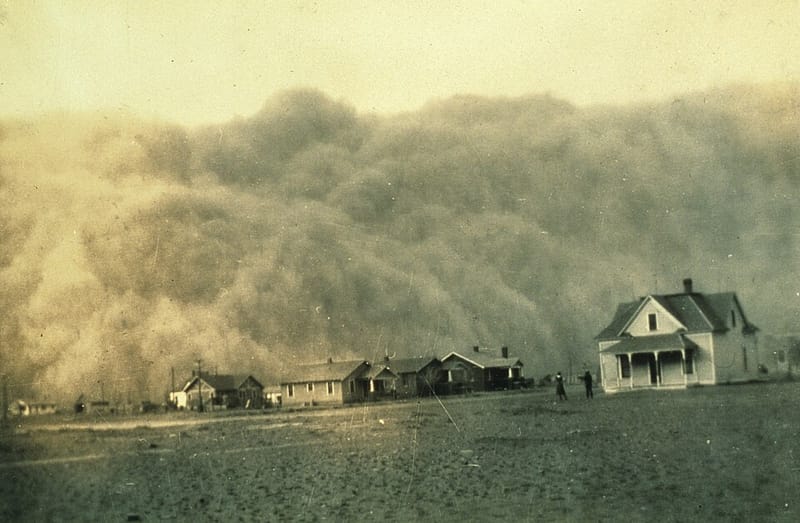
During the 1930s, years of drought combined with farming practices that had stripped the Great Plains of its protective grass, and high winds lifted the exposed soil into enormous dust storms. The worst-hit area — the western third of Kansas, southeastern Colorado, the Oklahoma Panhandle, most of the Texas Panhandle, and northeastern New Mexico — became known as the Dust Bowl. Farms failed, hundreds of thousands of people left the region, and the disaster pushed the federal government to promote soil conservation.
Key facts
- Date
- c. 1930–1940
- Location
- Southern Great Plains: western Kansas, southeastern Colorado, the Oklahoma Panhandle, the Texas Panhandle, and northeastern New Mexico
- Dating note
- Four distinct droughts struck in 1930–31, 1934, 1936, and 1939–40; near-normal rainfall returned around 1941.
- Droughts
- 1930–31, 1934, 1936, and 1939–40
- Black Sunday
- April 14, 1935
- Name
- Coined by Associated Press reporter Robert Geiger in April 1935
- Relief
- By 1937, 21% of rural Plains families received federal emergency relief
- Outmigration
- Oklahoma lost 440,000 people, 18.4% of its 1930 population
Why it matters
The Dust Bowl was one of the worst environmental disasters in American history, a human-made catastrophe as much as a natural one, and it changed how Americans farm and manage land.
Historical background
In the 1920s, low crop prices and high machinery costs pushed Plains farmers to plow marginal land, and many abandoned soil conservation practices. Plowing destroyed the native sod that had held the dry soil in place; relatively wet years had masked the danger.
Causes and contributing factors
Drought covered almost the entire Plains for nearly a decade, in at least four distinct episodes that came too quickly for the land to recover. With the ground cover gone and few windbreaks, high winds churned the dry topsoil into storms that people called “black blizzards” or “dusters.” The disaster struck farmers already ruined by years of falling prices and foreclosures during the Great Depression.
What happened
Dust storms blotted out the sun, choked people and livestock,. Some carried dirt as far east as Washington, D.C., New England, and ships on the Atlantic. The worst came on Sunday, April 14, 1935 — “Black Sunday” — when a towering wall of dust swept across the Oklahoma and Texas panhandles, turning afternoon into total darkness. The next day an Associated Press reporter, Robert Geiger, who had been caught in the storm near Boise City, Oklahoma, wrote of the “dust bowl,” and the name stuck.
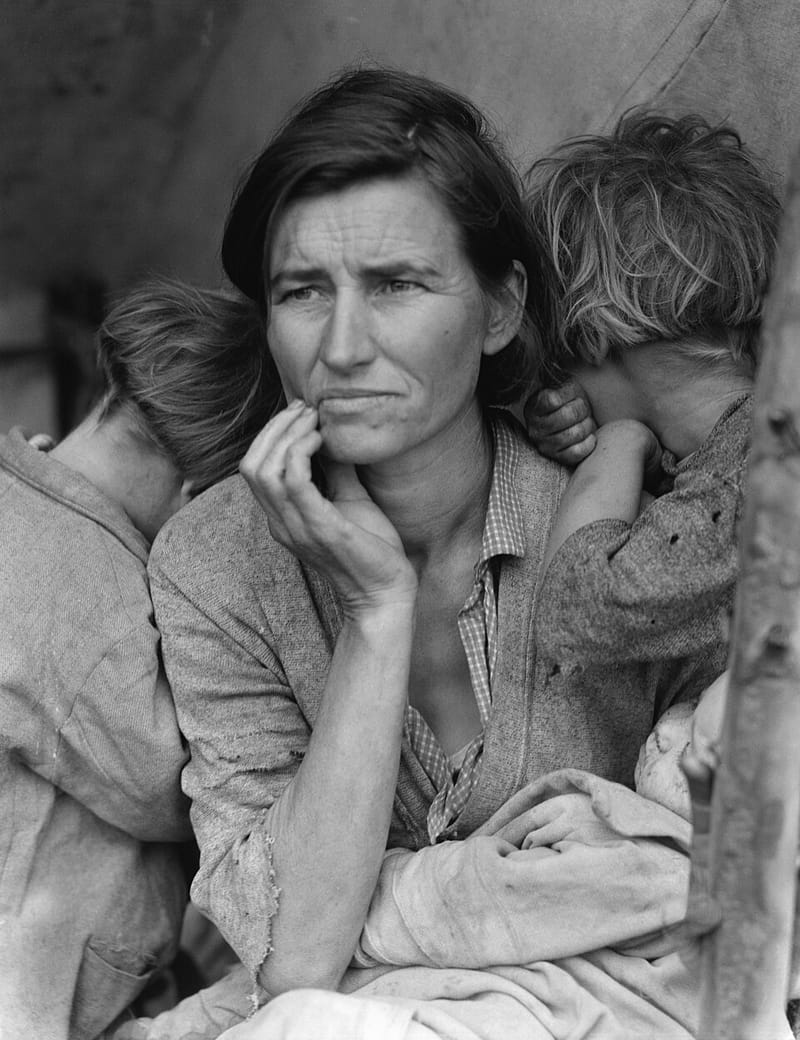
Crops failed across the region, and many families gave up. Hundreds of thousands headed west, especially to California; the migrants, many of them from Oklahoma, were disparagingly called “Okies.” Some states tried to keep them out, and California officials briefly blockaded the border in 1935–1936. Dorothea Lange’s 1936 photograph Migrant Mother, taken at a farmworkers’ camp in Nipomo, California, and John Steinbeck’s 1939 novel The Grapes of Wrath made the migrants’ hardship a national story.
Immediate consequences
Federal drought relief began in 1932, with funds specifically for drought relief released in the fall of 1933. In March 1935 soil scientist Hugh Hammond Bennett, a Roosevelt adviser, testified to Congress on the need for better soil conservation — by one widely told account, as dust from the Plains darkened the sky over Washington — and Congress passed the Soil Conservation Act that year. A 1937 Works Progress Administration bulletin reported that 21 percent of rural Plains families were on federal relief. Near-normal rains returned by 1941, and World War II revived the farm economy.
Long-term significance
The 1930s drought remains the nation’s “drought of record.” Its lessons — soil conservation, windbreaks, and government drought planning — reduced the damage when severe drought returned to the Plains in the 1950s.
Study this entry
Check your understanding
Try answering in your own words, then open the answer.
1.What led to the Dust Bowl?Show answerHide
Drought covered almost the entire Plains for nearly a decade, in at least four distinct episodes that came too quickly for the land to recover. With the ground cover gone and few windbreaks, high winds churned the dry topsoil into storms that people called “black blizzards” or “dusters.”From “Causes and contributing factors” above.
2.What happened?Show answerHide
Dust storms blotted out the sun, choked people and livestock,. Some carried dirt as far east as Washington, D.C., New England, and ships on the Atlantic.From “What happened” above.
3.What were the immediate consequences?Show answerHide
Federal drought relief began in 1932, with funds specifically for drought relief released in the fall of 1933.From “Immediate consequences” above.
4.Why does it still matter?Show answerHide
The 1930s drought remains the nation’s “drought of record.” Its lessons — soil conservation, windbreaks, and government drought planning — reduced the damage when severe drought returned to the Plains in the 1950s.From “Long-term significance” above.
Turn this entry into 10 flashcards (key facts, dates, and why it matters) and review them in Learn.
Related History
How this connects to the rest of the atlas.

Sources
- 1.The Dust Bowl
National Drought Mitigation Center, University of Nebraska–Lincoln · Scholarly · cited for drought episodes, region, causes, relief, migration
- 2.The Black Sunday Dust Storm of April 14, 1935
National Weather Service, Norman, Oklahoma · Institutional · cited for Black Sunday, naming of the Dust Bowl, Soil Conservation Act
- 3.The American Yawp, “The Great Depression”
The American Yawp (eds. Joseph Locke and Ben Wright; Stanford University Press) · Scholarly · cited for crash, Depression, New Deal, Dust Bowl
- 4.Great Depression Facts
Franklin D. Roosevelt Presidential Library and Museum (National Archives) · Institutional · cited for statistics
Image credits
- Dust Storm Texas 1935, George Everett Marsh Jr., 1935-04-18. Via Wikimedia Commons · Public domain · Source
Written for American History Atlas from the sources above. See how entries are researched.
Atlas by Alexander. More on Telegram.