PersonConservative Realignment and the End of the Cold War
Ronald Reagan
Fortieth president and leader of the conservative revival
1911–2004
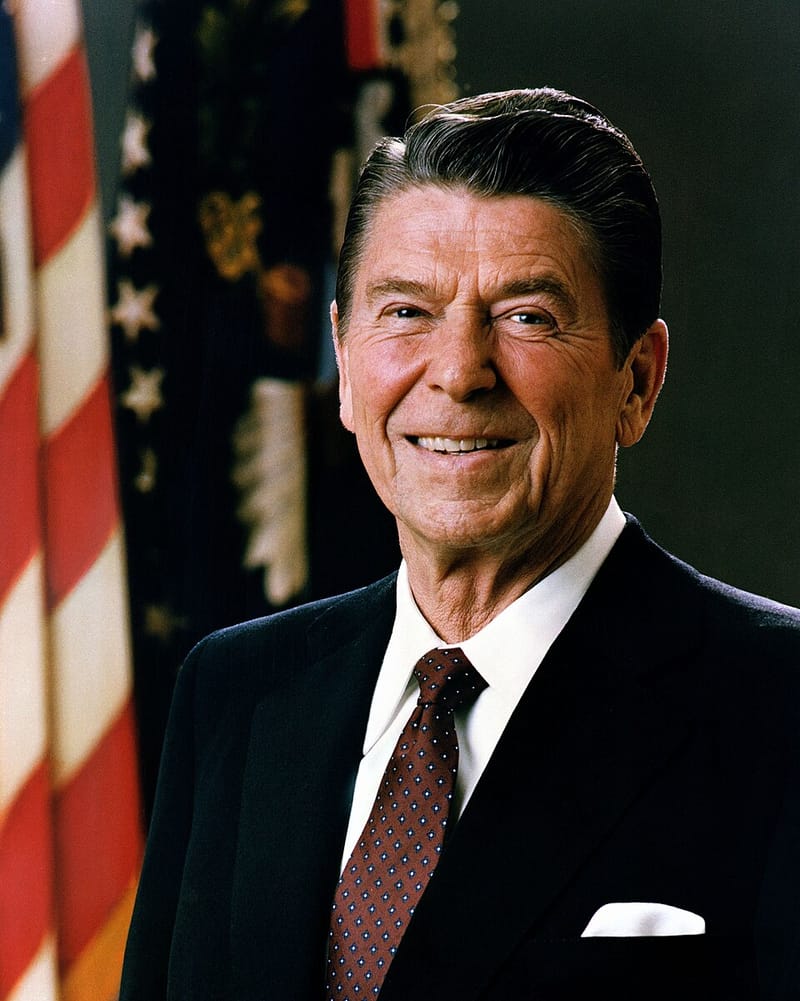
Ronald Reagan, the fortieth president of the United States (1981–1989), was a small-town Illinois boy who became a radio sportscaster, a Hollywood actor, the voice of General Electric, and a two-term governor of California before leading a resurgent conservative movement to the White House. He cut taxes sharply, built up the military, and declared that “government is the problem.” After a deep recession the economy recovered and he won a forty-nine-state landslide in 1984. He denounced the Soviet Union as an “evil empire,” then negotiated a landmark arms treaty with Mikhail Gorbachev as the Cold War wound down. His presidency also brought soaring deficits and the Iran-Contra scandal.
Key facts
- Born
- February 6, 1911, Tampico, Illinois
- Died
- June 5, 2004
- Roles
- Film actor and president of the Screen Actors Guild; Governor of California (1967–1975); Fortieth president (1981–1989)
- Born
- February 6, 1911, Tampico, Illinois
- Presidency
- 1981–1989; Republican
- Elections
- 1980 (489–49 electoral votes over Jimmy Carter); 1984 (49 states)
- Major policies
- 1981 tax cut; military buildup; INF Treaty with the Soviet Union (1987)
- Died
- June 5, 2004
Why it matters
Reagan was the defining political figure of the late twentieth century, the leader of a conservative realignment and a key actor in the end of the Cold War.
Early life and context
Reagan was born on February 6, 1911, in an apartment above a general store in Tampico, Illinois, and grew up in Dixon. His father, a shoe salesman, was an alcoholic — the boy once dragged him in from the snow — but also fiercely opposed to bigotry; his mother, a devout member of the Disciples of Christ, taught her sons compassion. For six summers Reagan worked as a lifeguard on the treacherous Rock River and, by contemporary reports, saved seventy-seven people from drowning. At Eureka College he played football, acted, led the student council, and graduated in 1932 with a C average.
As a radio announcer in Iowa he became known for his re-creations of Chicago Cubs baseball games. In 1937 a screen test won him a Warner Brothers contract, and over twenty years he made more than fifty films. As the dying football star George Gipp in Knute Rockne — All American (1940) he asked his coach to have the team “win just once for the Gipper” — a line he later used so often in politics that reporters nicknamed him “the Gipper.” Poor eyesight kept him out of combat in World War II; he made training films. He married actress Jane Wyman in 1940; they divorced in 1948, and in 1952 he married Nancy Davis.
Major actions and achievements
Reagan became president of the Screen Actors Guild in 1947 and led it again from 1959. A New Deal Democrat who voted four times for Franklin Roosevelt, he moved right in the 1950s as high taxes on his earnings and eight years of speeches at General Electric plants — he visited all 135 — turned his message into a warning against “Big Government.” He backed Richard Nixon in 1960 and formally became a Republican in 1962. His televised speech for Barry Goldwater on October 27, 1964 — “You and I have a rendezvous with destiny” — made him the conservatives’ new star, and in 1966 he was elected governor of California, serving two terms.
In 1980, amid high inflation and the Iran hostage crisis, Reagan defeated President Jimmy Carter, and Republicans won the Senate for the first time since 1955. In 1981 he survived an assassination attempt and won a $675 billion tax cut that reduced the top income tax rate from 70 to 50 percent, and he fired more than 11,000 striking air traffic controllers. A 1983 bipartisan reform shored up Social Security. Abroad he backed anticommunist forces worldwide, invaded Grenada in 1983, and launched the Strategic Defense Initiative. When Gorbachev came to power, the two leaders met at Geneva and Reykjavik and in 1987 signed the Intermediate Nuclear Forces Treaty; that year, at the Berlin Wall, Reagan challenged Gorbachev to “tear down this wall!”
Beliefs and ideas
Reagan’s creed, honed in hundreds of speeches, was individual freedom against an encroaching government at home and resistance to Communism abroad. He believed lower tax rates would spur investment and growth — the “supply-side” theory his administration embraced — and he sought “peace through strength.” His optimism and storytelling softened a stern message: that Americans were in danger of losing their liberty.
Controversies, limits, and criticism
Combined with higher defense spending, the tax cuts produced huge deficits: the national debt rose from $914 billion in 1980 to $2.7 trillion in 1989. A 1981–1982 recession pushed unemployment near 11 percent, and cuts to social programs fell hard on poor communities. His campaigns appealed to white racial resentments, including stories about a “welfare queen.” In Hollywood, as Screen Actors Guild president, he had helped carry out the studios’ blacklist of suspected Communists and secretly informed for the FBI. In the Iran-Contra affair, revealed in 1986, his aides secretly sold missiles to Iran and funneled the proceeds to Nicaraguan contra rebels in violation of a congressional ban, though investigators never proved Reagan knew.
Legacy
Reagan left office in 1989 with the Cold War waning and unemployment near 5 percent, but with economic gains unequally shared. He died on June 5, 2004. His presidency shifted the national debate decisively to the right for a generation.
Study this entry
Check your understanding
Try answering in your own words, then open the answer.
1.What shaped Ronald Reagan early in life?Show answerHide
Reagan was born on February 6, 1911, in an apartment above a general store in Tampico, Illinois, and grew up in Dixon.From “Early life and context” above.
2.What were Ronald Reagan’s major achievements?Show answerHide
Reagan became president of the Screen Actors Guild in 1947 and led it again from 1959.From “Major actions and achievements” above.
3.What criticism or controversy surrounds Ronald Reagan?Show answerHide
Combined with higher defense spending, the tax cuts produced huge deficits: the national debt rose from $914 billion in 1980 to $2.7 trillion in 1989. A 1981–1982 recession pushed unemployment near 11 percent, and cuts to social programs fell hard on poor communities.From “Controversies, limits, and criticism” above.
4.How is Ronald Reagan remembered?Show answerHide
Reagan left office in 1989 with the Cold War waning and unemployment near 5 percent, but with economic gains unequally shared. He died on June 5, 2004.From “Legacy” above.
Turn this entry into 9 flashcards (key facts, dates, and why it matters) and review them in Learn.
Related History
How this connects to the rest of the atlas.
People

Sources
- 1.Ronald Reagan: Life in Brief
Miller Center, University of Virginia · Scholarly · cited for life and presidency
- 2.Ronald Reagan: Impact and Legacy
Miller Center, University of Virginia · Scholarly · cited for legacy
- 3.The American Yawp, “The Triumph of the Right”
The American Yawp (eds. Joseph Locke and Ben Wright; Stanford University Press) · Scholarly · cited for 1980 election, Reaganomics, Iran-Contra, end of the Cold War
- 4.Ronald Reagan: Life Before the Presidency
Miller Center, University of Virginia · Scholarly · cited for childhood, radio, Hollywood, Screen Actors Guild, GE, turn to conservatism
Image credits
- Official Portrait of President Reagan 1981, Michael Evans, Taken on 7 February 1981. Via Wikimedia Commons · Public domain · Source
Written for American History Atlas from the sources above. See how entries are researched.
Atlas by Alexander. More on Telegram.