PersonThe United States in the Twenty-First Century
Donald Trump
Forty-fifth and forty-seventh president, the second ever elected to non-consecutive terms
born 1946
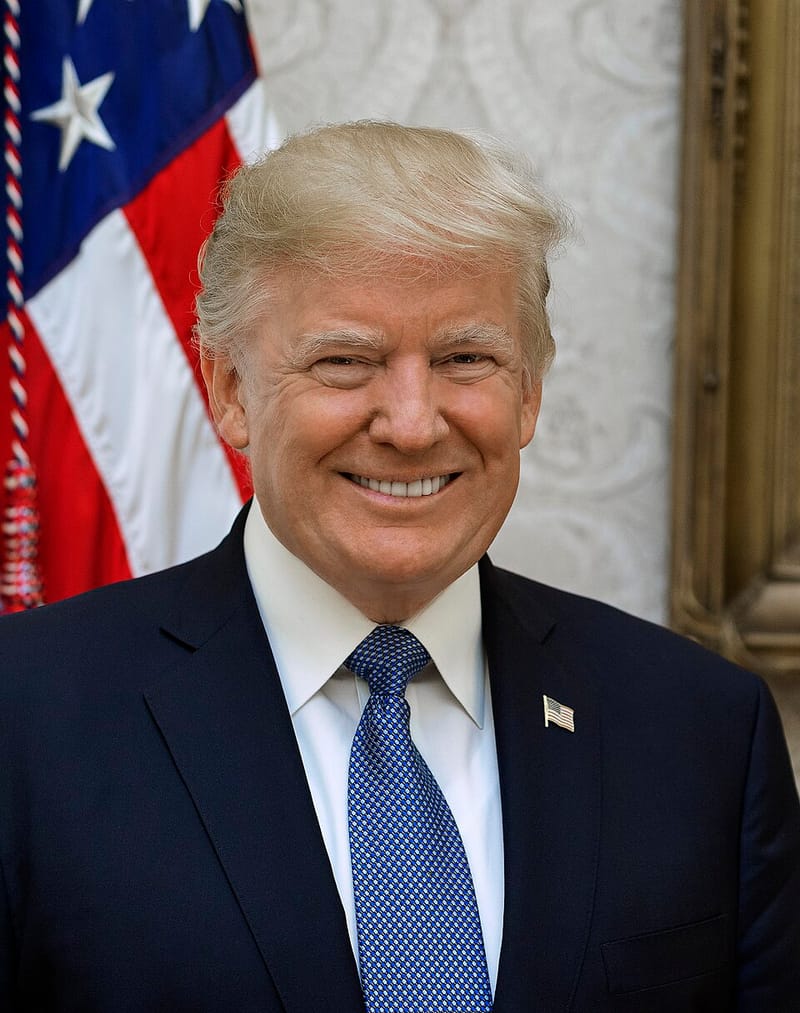
Donald Trump, a New York real estate developer and reality-television star, won the presidency in 2016 as a Republican in a surprise victory, without ever having held public office or military command. His first term brought a large tax cut, tighter immigration policies, new tariffs, and an “America First” foreign policy, along with intense partisan division and two impeachments, both ending in acquittal. He lost the 2020 election to Joe Biden, refused to concede, and his supporters attacked the Capitol on January 6, 2021. In 2024, after being convicted on state felony charges in New York, he won the presidency again, becoming only the second president elected to non-consecutive terms.
Key facts
- Born
- June 14, 1946, Queens, New York City
- Roles
- Real estate developer and businessman; Television personality (The Apprentice); Forty-fifth president (2017–2021); Forty-seventh president (2025– )
- Presidencies
- January 20, 2017 – January 20, 2021; second term began January 20, 2025; Republican
- 2016 election
- Won the Electoral College 304–227 while Hillary Clinton won 2.8 million more popular votes
- 2024 election
- Beat Kamala Harris 312–226 in the Electoral College and 49.9% to 48.4% in the popular vote
- Firsts
- First president with no prior public office or military leadership; first impeached twice; first convicted of a felony
- Non-consecutive terms
- The second president elected to non-consecutive terms, and the first since the nineteenth century
Why it matters
Trump put populist nationalism — opposition to immigration and free trade and skepticism of foreign alliances — at the center of Republican politics, and he broke with long-standing norms, above all by refusing to concede the 2020 election. Because his second term is under way, this entry covers events through its beginning; historians’ assessments are still forming.
Early life and context
Donald John Trump was born on June 14, 1946, in the borough of Queens in New York City, the fourth of five children of Mary Anne MacLeod Trump and Fred Trump, a residential real estate developer. After graduating from the Wharton School of the University of Pennsylvania in 1968, he took over his father’s business and expanded it into hotels, casinos, golf courses, beauty pageants, and branded products. In the 1970s and 1980s he cultivated an image as the embodiment of the high life; several of his businesses, including casinos, went through bankruptcies, but his brand remained strong. In the 2000s he starred in the reality show The Apprentice. Politically, he identified at different times as a Democrat, a Republican, an independent, and a member of the Reform Party, and he considered running for president several times. During the Obama years he became a leading promoter of the false “birther” claim that Barack Obama had not been born in the United States, which he did not abandon until September 2016.
Major actions and achievements
Trump announced his candidacy on June 16, 2015, at Trump Tower in Manhattan, promising to “Make America Great Again,” to build a wall on the Mexican border, and to put “America First.” He defeated sixteen major rivals for the Republican nomination and, though most polls favored Hillary Clinton, won narrow victories in Pennsylvania, Michigan, and Wisconsin to take the Electoral College.
In office he signed the Tax Cuts and Jobs Act of 2017, which lowered corporate and individual tax rates and eliminated the Affordable Care Act’s individual mandate penalty, though efforts to repeal the act itself failed. He restricted immigration, including an order barring visas for citizens of several majority-Muslim countries, and new barriers were built along more than 450 miles of the southern border. Abroad he withdrew from the Paris climate agreement, the Trans-Pacific Partnership, and the Iran nuclear deal; replaced NAFTA with the United States–Mexico–Canada Agreement; imposed tariffs on Chinese goods; moved the U.S. embassy in Israel to Jerusalem; and met North Korea’s Kim Jong-un three times, becoming the first sitting president to set foot in North Korea. His administration brokered the Abraham Accords normalizing relations between Israel and the United Arab Emirates and Bahrain. When the Covid-19 pandemic struck in 2020, he declared a national emergency and signed the $2.2 trillion CARES Act, and public health experts credited his administration with speeding the development of vaccines.
Beliefs and ideas
Trump’s “America First” program combined economic nationalism with skepticism of foreign commitments. He blamed free trade and “bad deals” for the decline of American manufacturing, favored tariffs and country-by-country agreements over multilateral ones, called for sharply reduced immigration, and argued that defending Western Europe through NATO was too expensive. He presented himself as a dealmaker and an outsider fighting a corrupt political establishment, and he communicated directly with supporters through rallies and social media.
Controversies, limits, and criticism
His presidency was marked by intense partisan division. Critics condemned his rhetoric about immigrants as racist; his 2018 “zero tolerance” policy separated at least 2,300 children from their parents at the border before he reversed it. The special counsel Robert Mueller found that Russia had interfered in the 2016 election to help him but did not find clear evidence that his campaign conspired with Russia, and on obstruction of justice said his report “does not conclude that the president committed a crime” but “also does not exonerate” him. Critics faulted his handling of Covid-19, during which he often downplayed the risks. The House impeached him in December 2019 for pressing Ukraine’s president to interfere in the upcoming U.S. election, and again in January 2021 after he refused to accept his defeat by Joe Biden — who won about 7 million more votes and 306 electoral votes — and his supporters stormed the Capitol on January 6. The Senate acquitted him both times. In May 2024 a New York jury convicted him on 34 felony counts of falsifying business records in connection with a hush-money payment; after his reelection he was sentenced to an unconditional discharge, and he announced an appeal.
Legacy
Trump’s 2024 victory over Vice President Kamala Harris made him, at seventy-eight, the oldest person ever inaugurated, and the first president since the nineteenth century elected to non-consecutive terms. He took the oath for the second time on January 20, 2025. His presidencies remain the subject of intense debate, and a full historical assessment will have to wait until his time in office is over.
Study this entry
Check your understanding
Try answering in your own words, then open the answer.
1.What shaped Donald Trump early in life?Show answerHide
Donald John Trump was born on June 14, 1946, in the borough of Queens in New York City, the fourth of five children of Mary Anne MacLeod Trump and Fred Trump, a residential real estate developer.From “Early life and context” above.
2.What were Donald Trump’s major achievements?Show answerHide
Trump announced his candidacy on June 16, 2015, at Trump Tower in Manhattan, promising to “Make America Great Again,” to build a wall on the Mexican border, and to put “America First.”From “Major actions and achievements” above.
3.What criticism or controversy surrounds Donald Trump?Show answerHide
His presidency was marked by intense partisan division. Critics condemned his rhetoric about immigrants as racist; his 2018 “zero tolerance” policy separated at least 2,300 children from their parents at the border before he reversed it.From “Controversies, limits, and criticism” above.
4.How is Donald Trump remembered?Show answerHide
Trump’s 2024 victory over Vice President Kamala Harris made him, at seventy-eight, the oldest person ever inaugurated, and the first president since the nineteenth century elected to non-consecutive terms. He took the oath for the second time on January 20, 2025.From “Legacy” above.
Turn this entry into 11 flashcards (key facts, dates, and why it matters) and review them in Learn.
Related History
How this connects to the rest of the atlas.
People

Sources
- 1.Donald Trump (overview and fast facts)
Miller Center, University of Virginia · Scholarly · cited for dates, family, education, terms
- 2.Donald Trump: Life in Brief
Miller Center, University of Virginia (Benjamin C. Waterhouse) · Scholarly · cited for background, firsts, elections, impeachments, conviction
- 3.Donald Trump: Campaigns and Elections
Miller Center, University of Virginia (Benjamin C. Waterhouse) · Scholarly · cited for early politics, birther claims, 2016 campaign
- 4.Donald Trump: Domestic Affairs
Miller Center, University of Virginia (Benjamin C. Waterhouse) · Scholarly · cited for taxes, health care, immigration, Mueller investigation, Covid-19
- 5.Donald Trump: Foreign Affairs
Miller Center, University of Virginia (Benjamin C. Waterhouse) · Scholarly · cited for America First, treaties, trade, North Korea, Abraham Accords
Image credits
- President Donald Trump, Shealah Craighead, The White House, 2017-10-06. Via Wikimedia Commons · Public domain · Source
Written for American History Atlas from the sources above. See how entries are researched.
Atlas by Alexander. More on Telegram.