PersonCivil Rights and Social Transformation
Muhammad Ali
Three-time heavyweight champion who gave up his title rather than fight in Vietnam
1942–2016
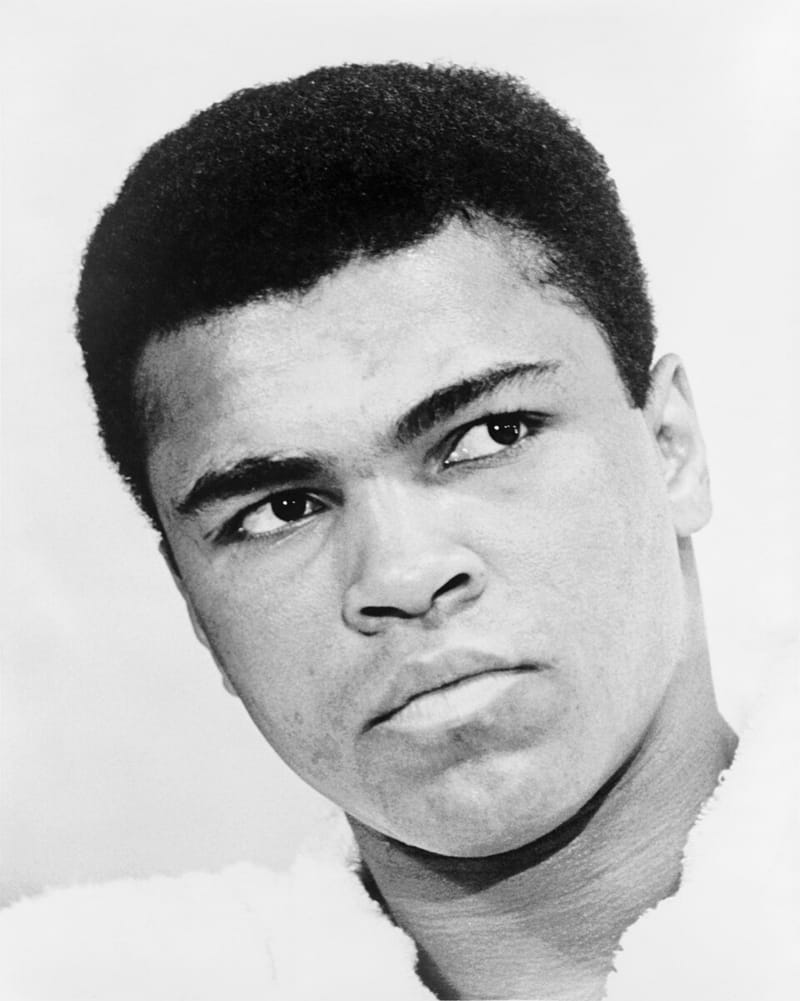
Muhammad Ali, born Cassius Clay in segregated Louisville, won Olympic gold at eighteen and the world heavyweight title at twenty-two. That year he announced that he had joined the Nation of Islam and taken a new name. In 1967 he refused induction into the Army during the Vietnam War, citing his faith; he was stripped of his title, convicted, and barred from boxing until the Supreme Court overturned his conviction in 1971. He regained the championship twice, and after Parkinson’s disease ended his public career he became a worldwide symbol of conviction and humanitarian work.
Key facts
- Born
- January 17, 1942, Louisville, Kentucky
- Died
- June 2016
- Roles
- Olympic gold medalist (Rome, 1960); Three-time world heavyweight champion; Conscientious objector to the Vietnam War; United Nations Messenger of Peace (2002)
- Olympic gold
- Light heavyweight, Rome, 1960, at age eighteen
- First title
- Beat Sonny Liston in Miami on February 25, 1964
- Refusal
- Refused induction into the Army in 1967; stripped of his title and convicted
- Supreme Court
- Clay v. United States (1971) unanimously reversed his conviction
- Famous fights
- Lost to Joe Frazier (1971); beat George Foreman in Zaire, the “Rumble in the Jungle” (1974)
- Olympic flame
- Lit the cauldron at the 1996 Atlanta Games
Why it matters
Ali joined a champion’s boxing career to the politics of the civil rights movement and opposition to the Vietnam War. By sacrificing his title for his beliefs, he showed that an athlete could take a public stand — and inspired others, including the athletes who protested at the 1968 Olympics.
Early life and context
Cassius Marcellus Clay Jr. was born on January 17, 1942, in Louisville, Kentucky, and grew up with his parents, Odessa and Cassius Clay Sr., and his brother, Rudolph, in a house at 3302 Grand Avenue in the city’s West End. He attended mostly Black public schools. When his bicycle was stolen, a city policeman introduced him to boxing; Joe Martin became his first trainer. Boxing soon came before everything; at Central High School his studies suffered.
At eighteen he made the 1960 U.S. Olympic team. He was so afraid of flying after a rough flight to the trials that he nearly refused to go to Rome; the story goes that he bought a parachute at an army surplus store and wore it for the whole flight. In Rome he called himself the King of the Olympic Village, became one of its best-liked athletes, and won the light heavyweight gold medal. Later that year he turned professional.
Major actions and achievements
On February 25, 1964, in Miami, the young challenger knocked out Sonny Liston in the seventh round to become heavyweight champion of the world. Just before the fight he publicly announced his conversion to the Nation of Islam, and he declared: “Cassius Clay is a slave name. I didn’t choose it, and I don’t want it. I am Muhammad Ali, a free name — it means beloved of God.” He became a close friend of Malcolm X, though he stayed with Elijah Muhammad’s Nation when Malcolm broke with it.
In 1967, at the height of the Vietnam War, Ali was drafted. He claimed exemption as a conscientious objector on religious grounds, and when the claim was denied he refused to be inducted. He was stripped of his title, his passport was taken, he was convicted of refusing induction, and he could not box for years at the peak of his career. In June 1971 the Supreme Court, in Clay v. United States, unanimously reversed his conviction because the draft appeal board had given no reason for rejecting his claim.
Back in the ring, Ali lost to Joe Frazier in 1971. In 1974 in Zaire he regained the championship by beating George Foreman in the “Rumble in the Jungle.” He lost the title to Leon Spinks early in 1978 and won it back that fall. His last fight, against Larry Holmes in 1980, ended in defeat in the eleventh round.
Beliefs and ideas
Ali’s faith guided his life. The Nation of Islam promoted Black self-determination and rejected the nonviolent strategy of leaders like Martin Luther King Jr.; Ali insisted on his Muslim name and based his refusal to serve in Vietnam on his religion. Later he devoted himself to humanitarian causes and spoke of six core principles — confidence, conviction, dedication, giving, respect, and spirituality — and of sport as a force that could unite people and treat everyone fairly.
Controversies, limits, and criticism
Ali’s stand cost him dearly: he was convicted of a federal crime, banned from boxing in his prime, and lost his passport. His loyalty to Elijah Muhammad led him to side against his friend Malcolm X after their split. In the fall of 1984 he was diagnosed with Parkinson’s disease.
Legacy
As his illness advanced, Ali appeared in public less often — which made his surprise appearance at the 1996 Atlanta Olympics, where he lit the Olympic cauldron, all the more moving. In 1980 President Jimmy Carter had sent him to Africa to promote the boycott of the Moscow Olympics, and in 2002 he was named a United Nations Messenger of Peace. The Muhammad Ali Center in Louisville tells his story. When he died in June 2016, his casket was driven past his childhood home and through Louisville’s West End; he is buried in the city’s Cave Hill Cemetery, and in 2019 Louisville’s airport was renamed in his honor.
Study this entry
Check your understanding
Try answering in your own words, then open the answer.
1.What shaped Muhammad Ali early in life?Show answerHide
Cassius Marcellus Clay Jr. was born on January 17, 1942, in Louisville, Kentucky, and grew up with his parents, Odessa and Cassius Clay Sr., and his brother, Rudolph, in a house at 3302 Grand Avenue in the city’s West End. He attended mostly Black public schools.From “Early life and context” above.
2.What were Muhammad Ali’s major achievements?Show answerHide
On February 25, 1964, in Miami, the young challenger knocked out Sonny Liston in the seventh round to become heavyweight champion of the world. Just before the fight he publicly announced his conversion to the Nation of Islam, and he declared: “Cassius Clay is a slave name.From “Major actions and achievements” above.
3.What criticism or controversy surrounds Muhammad Ali?Show answerHide
Ali’s stand cost him dearly: he was convicted of a federal crime, banned from boxing in his prime, and lost his passport. His loyalty to Elijah Muhammad led him to side against his friend Malcolm X after their split.From “Controversies, limits, and criticism” above.
4.How is Muhammad Ali remembered?Show answerHide
As his illness advanced, Ali appeared in public less often — which made his surprise appearance at the 1996 Atlanta Olympics, where he lit the Olympic cauldron, all the more moving.From “Legacy” above.
Turn this entry into 12 flashcards (key facts, dates, and why it matters) and review them in Learn.
Related History
How this connects to the rest of the atlas.
People

Sources
- 1.Muhammad Ali’s Home Site (Historical Marker #2339)
ExploreKYHistory, Kentucky Historical Society · Institutional · cited for childhood, Olympics, Liston fight, name change, draft case, later fights, death
- 2.Muhammad Ali: An Olympic Life
Muhammad Ali Center · Institutional · cited for 1960 Olympics, 1968 protests, Carter mission, Parkinson’s diagnosis, 1996 cauldron
- 3.Clay v. United States
Oyez (Cornell LII, Justia, Chicago-Kent College of Law) · Reference · cited for conscientious objector claim, conviction reversed
Image credits
- Muhammad Ali, Ira Rosenberg, World Journal Tribune, 1967. Via Wikimedia Commons · Public domain · Source
Written for American History Atlas from the sources above. See how entries are researched.
Atlas by Alexander. More on Telegram.