DocumentIndustrialization and the Gilded Age
The Chinese Exclusion Act
The first federal law to bar immigrants by nationality, 1882
May 6, 1882
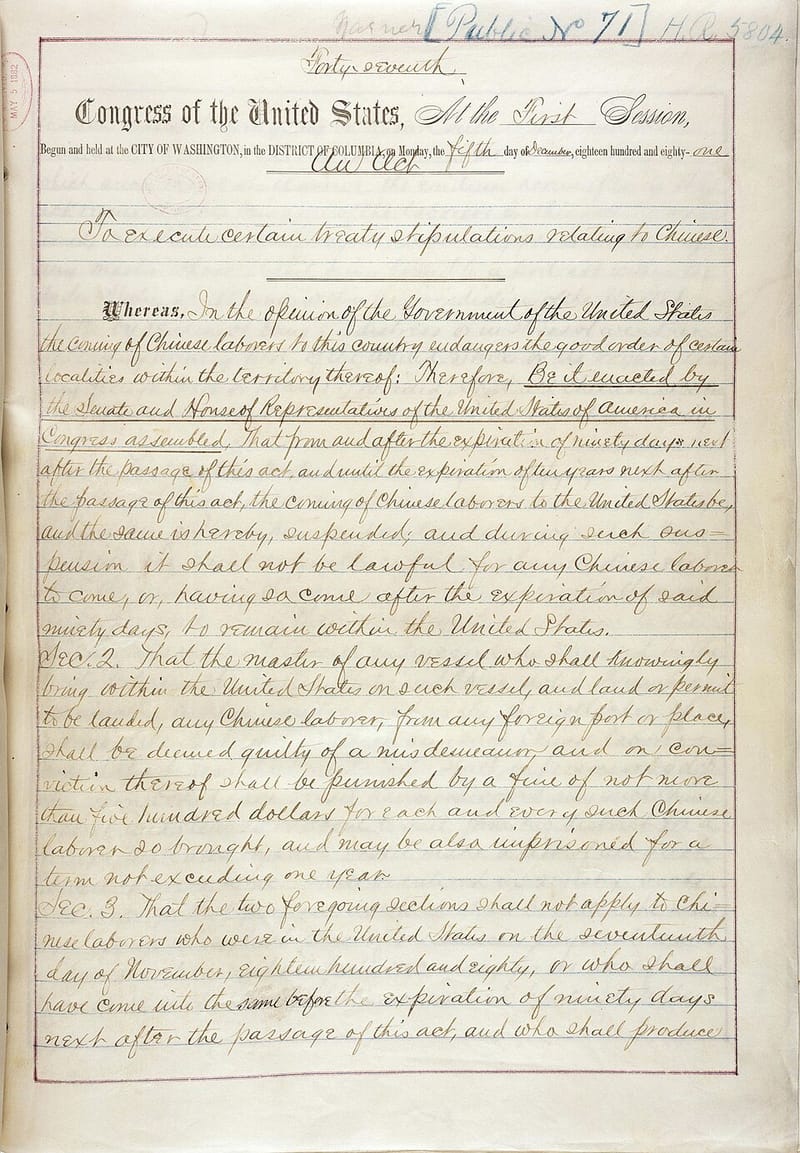
The Chinese Exclusion Act of 1882 barred Chinese laborers from immigrating to the United States for ten years — the first time federal law excluded people on the basis of nationality and race. Extended and tightened in 1892 and made permanent in 1902, exclusion lasted until 1943. It shaped Chinese American life for generations and set the pattern for later laws restricting immigration from Asia and other parts of the world.
Key facts
- Date
- May 6, 1882
- Authors
- Forty-seventh Congress; Signed by President Chester A. Arthur
- Dating note
- Signed May 6, 1882; extended in 1892 (Geary Act), made permanent in 1902, repealed in 1943.
- Signed
- May 6, 1882, by President Chester A. Arthur
- Provision
- A ten-year ban on Chinese laborers, skilled and unskilled
- Other terms
- Barred Chinese immigrants from naturalization; required certificates to re-enter
- Extended
- Geary Act (1892); made permanent (1902)
- Repealed
- 1943, during World War II
Read the act at the National Archives
Why it matters
The act made race and nationality explicit grounds for excluding immigrants. The Geary Act of 1892 added a requirement that every Chinese resident register and carry a certificate of residence or face deportation. On the West Coast, the Angel Island Immigration Station was built to detain and interrogate Chinese arrivals. The precedent shaped the national-origins quotas of the Immigration Act of 1924, which barred nearly all immigration from Asia. Congress repealed Chinese exclusion in 1943, when China was a wartime ally.
Historical circumstances
Chinese immigrants, mostly from Guangdong Province, came to California from the 1850s, driven by famine, rebellion, and economic collapse at home. Welcomed at first as laborers in the gold fields and on the railroads, they became scapegoats when the economy faltered in the 1870s. Politicians and labor leaders in the West stirred anti-Chinese hostility, and states and cities passed laws restricting where Chinese people could live and work. Because the 1868 Burlingame-Seward Treaty with China protected Chinese immigration, the federal government first negotiated the Angell Treaty of 1880, which allowed the United States to restrict — though not completely prohibit — Chinese immigration.
Principal ideas
- Exclusion of laborers. Chinese laborers, defined as “skilled and unskilled… and Chinese employed in mining,” were barred for ten years.
- Narrow exceptions. Merchants, diplomats, students, and other non-laborers could enter only with certification from the Chinese government — difficult to obtain in practice.
- No naturalization. Federal and state courts were forbidden to grant citizenship to Chinese immigrants, who could still be deported.
- Re-entry certificates. Chinese residents who left the country needed certificates to return.
Study this entry
Check your understanding
Try answering in your own words, then open the answer.
1.Why was this document written?Show answerHide
Chinese immigrants, mostly from Guangdong Province, came to California from the 1850s, driven by famine, rebellion, and economic collapse at home. Welcomed at first as laborers in the gold fields and on the railroads, they became scapegoats when the economy faltered in the 1870s.From “Historical circumstances” above.
2.What are its principal ideas?Show answerHide
- Exclusion of laborers. Chinese laborers, defined as “skilled and unskilled… and Chinese employed in mining,” were barred for ten years. - Narrow exceptions. Merchants, diplomats, students, and other non-laborers could enter only with certification from the Chinese government — difficult to obtain in practice. - No naturalization. Federal and state courts were forbidden to grant citizenship to Chinese immigrants, who could still be deported. - Re-entry certificates. Chinese residents who left the country needed certificates to return.From “Principal ideas” above.
Turn this entry into 12 flashcards (key facts, dates, and why it matters) and review them in Learn.
Related History
How this connects to the rest of the atlas.
Events
Documents


Sources
- 1.Chinese Exclusion Act (1882) — Milestone Documents
National Archives · Primary source · cited for provisions, Geary Act, 1924
- 2.Chinese Immigration and the Chinese Exclusion Acts
U.S. Department of State, Office of the Historian · Institutional · cited for Burlingame and Angell treaties, extensions
- 3.History of Angel Island Immigration Station
Angel Island Immigration Station Foundation · Institutional · cited for Angel Island, exclusion, detention
- 4.Repeal of the Chinese Exclusion Act, 1943
U.S. Department of State, Office of the Historian · Institutional · cited for 1943 repeal
Image credits
- Chineseexclusionact, This work is in the public domain in the United States because it is a work prepared by an officer or employee of the United States Federal Government as part of that person’s official duties under the terms of Title 17, Chapter 1, Section 105 of the US Code . Note : This only applies to original works of the Federal Government and not to the work of any individual U.S. state , territory , commonwealth, county, municipality, or any other subdivision. This template also does not apply to postage stamp designs published by the United States Postal Service since 1978 . (See § 313.6(C)(1) of Compendium of U.S. Copyright Office Practices). It also does not apply to certain US coins; see The US Mint Terms of Use ., 1882. Via Wikimedia Commons · Public domain · Source
Written for American History Atlas from the sources above. See how entries are researched.
Atlas by Alexander. More on Telegram.