DocumentRevolution and Independence
Articles of Confederation
The first constitution of the United States, 1781–1789
November 15, 1777 – March 1, 1781
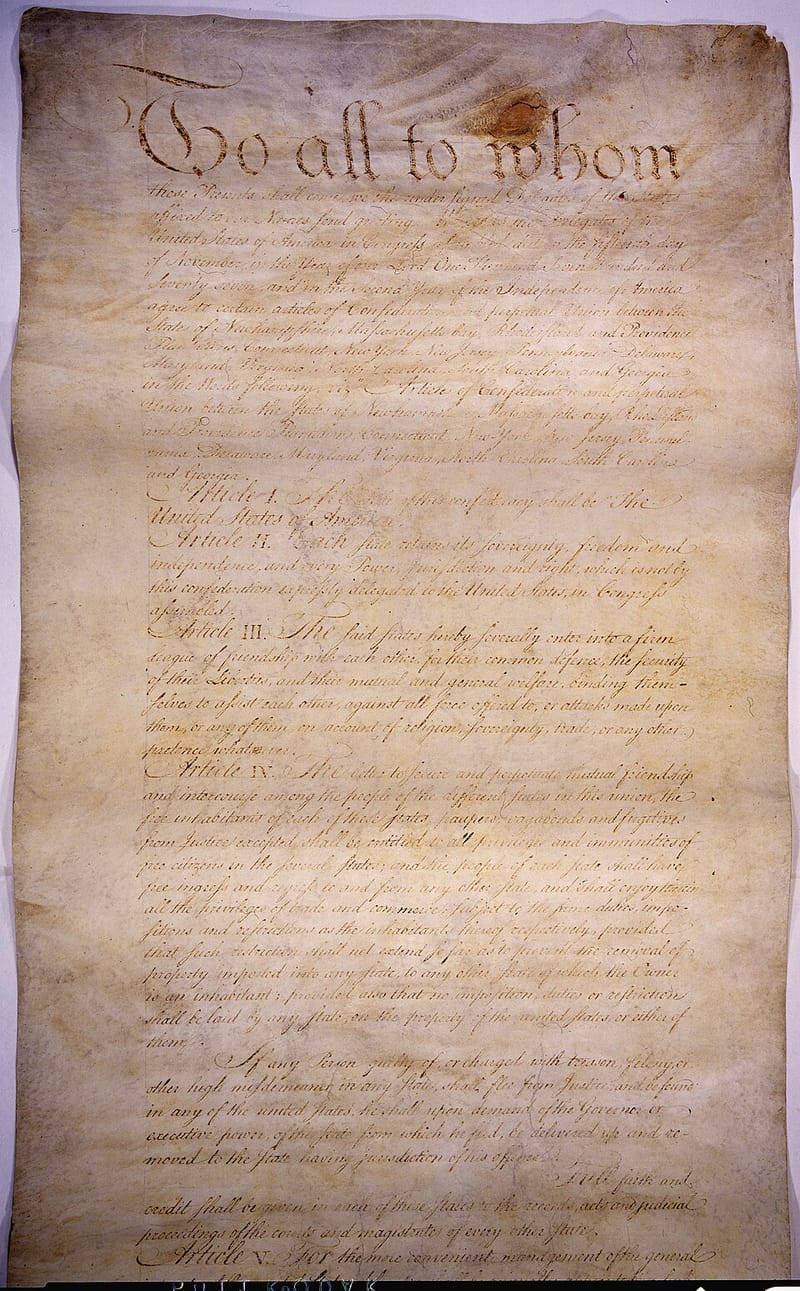
The Articles of Confederation created the first government of the United States: a “league of friendship” among thirteen sovereign states, with a one-house Congress in which each state had a single vote. Written during the Revolution by men wary of distant central power, the Articles gave Congress little ability to tax, regulate trade, or enforce its decisions. Their weaknesses led directly to the Constitutional Convention of 1787.
Key facts
- Date
- November 15, 1777 – March 1, 1781
- Authors
- John Dickinson (principal drafter); Second Continental Congress
- Dating note
- Adopted by Congress November 15, 1777; in force from March 1, 1781, after Maryland’s ratification, until 1789.
- Drafted by
- A committee led by John Dickinson of Delaware, appointed June 1776
- Adopted
- November 15, 1777
- In force
- March 1, 1781 – 1789
- Representation
- One vote per state, regardless of population
- Amendment
- Required the consent of all thirteen states
Read the full text at the National Archives
Why it matters
The Articles carried the United States through the end of the Revolution and produced one major achievement, the Northwest Ordinance. But a Congress that could not raise revenue, pay its debts, or settle disputes among the states persuaded many leaders that the union was in danger — and that persuaded them to write the Constitution.
Historical circumstances
On June 11, 1776, alongside the committee drafting the Declaration, the Second Continental Congress appointed a committee — one member from each colony — to plan a confederation. John Dickinson wrote the main draft, which named the confederation “the United States of America.” After long debate, Congress adopted a revised version on November 15, 1777.
The Articles required ratification by every state, and disputes over representation, voting, and western lands delayed it for more than three years. States with no western claims, led by Maryland, refused to ratify until states such as Virginia agreed to cede their claims beyond the Appalachians to the union. Maryland finally ratified on March 1, 1781, and the Articles took effect.
Principal ideas
- State sovereignty. Article II declared that each state “retains its sovereignty, freedom and independence,” and every power not “expressly delegated” to Congress.
- A league, not a nation. The states entered “a firm league of friendship” for common defense and mutual welfare.
- A limited Congress. Congress could make war and peace, conduct diplomacy, and manage relations with Native nations, but it could not tax, regulate commerce, or compel the states to supply money or troops. Major decisions required nine of thirteen states, and amendments required all thirteen.
- No executive or national courts. There was no president and no federal judiciary.
Why the Articles failed
Within a few years of the war’s end, James Madison and George Washington were among those who feared the country was on the brink of collapse. Congress depended on requisitions the states often ignored, its treasury was empty, and paper money had produced severe inflation. States quarreled over territory, trade, and taxation, and Congress had no power to settle the disputes. Abroad, foreign governments saw little reason to negotiate with a body that could not make its own states honor treaties. Shays’ Rebellion in Massachusetts in 1786–87 showed that the national government could not even help put down an armed uprising.
Study this entry
Check your understanding
Try answering in your own words, then open the answer.
1.Why was this document written?Show answerHide
On June 11, 1776, alongside the committee drafting the Declaration, the Second Continental Congress appointed a committee — one member from each colony — to plan a confederation. John Dickinson wrote the main draft, which named the confederation “the United States of America.”From “Historical circumstances” above.
2.What are its principal ideas?Show answerHide
- State sovereignty. Article II declared that each state “retains its sovereignty, freedom and independence,” and every power not “expressly delegated” to Congress. - A league, not a nation. The states entered “a firm league of friendship” for common defense and mutual welfare. - A limited Congress. Congress could make war and peace, conduct diplomacy, and manage relations with Native nations, but it could not tax, regulate commerce, or compel the states to supply money or troops.From “Principal ideas” above.
Turn this entry into 11 flashcards (key facts, dates, and why it matters) and review them in Learn.
Related History
How this connects to the rest of the atlas.
Events

People
Documents
Institutions


Sources
- 1.Articles of Confederation (1777) — Milestone Documents
National Archives · Primary source · cited for drafting, adoption, ratification, provisions, weaknesses
- 2.Articles of Confederation, 1777–1781
U.S. Department of State, Office of the Historian · Institutional · cited for origins and foreign-policy limits
Image credits
- Articles page1, The U.S. Government., 1777-11-15. Via Wikimedia Commons · Public domain · Source
Written for American History Atlas from the sources above. See how entries are researched.
Atlas by Alexander. More on Telegram.