PersonThe Twenties and the Great Depression
Amelia Earhart
The first woman to fly solo across the Atlantic, who vanished over the Pacific in 1937
1897–1937
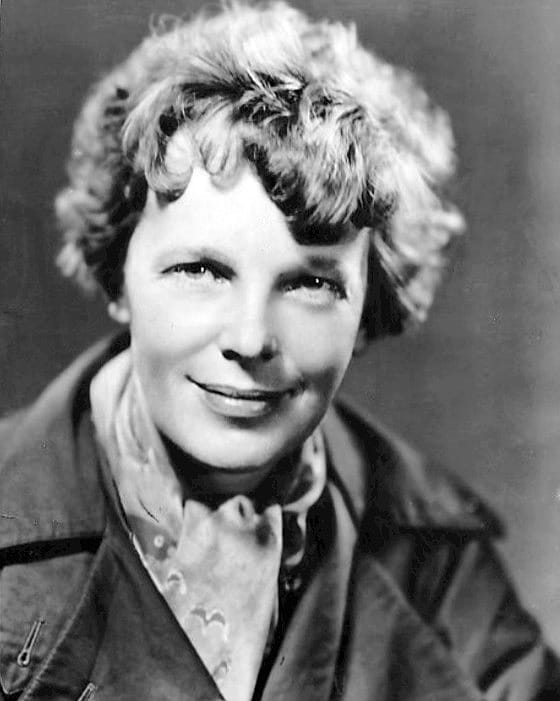
Amelia Earhart was one of the most influential pioneers of American aviation. In 1928 she became the first woman to cross the Atlantic by air — as a passenger — and in 1932 she flew it alone, five years to the day after Charles Lindbergh. She set record after record, including the first solo flight from Hawaiʻi to California, and used her fame to argue that women could do any job that men could. On July 2, 1937, nearing the end of an attempt to fly around the world, she and her navigator, Fred Noonan, vanished near tiny Howland Island in the Pacific. No trace of them was ever found.
Key facts
- Born
- 1897, Atchison, Kansas
- Died
- July 2, 1937, Disappeared near Howland Island, Pacific Ocean
- Roles
- Aviator; Author and lecturer; Career adviser at Purdue University (1935–1937)
- First flight as passenger
- June 1928: the first woman to cross the Atlantic by air
- Solo Atlantic
- May 20–21, 1932, Newfoundland to Ireland — the first woman, and the second person after Lindbergh
- Honors
- The Distinguished Flying Cross, the first awarded to a woman
- Pacific
- January 11, 1935: first person to fly solo from Honolulu to Oakland
- Disappearance
- July 2, 1937, with navigator Fred Noonan, on the flight from Lae, New Guinea, to Howland Island
Why it matters
Earhart turned aviation into a cause for women’s equality, proving in the most public way possible that women could match men in skill and daring. Her unexplained disappearance made her a lasting American legend.
Early life and context
Amelia Mary Earhart was born in Atchison, Kansas, in 1897. As a girl she climbed trees, “belly slammed” her sled downhill, and hunted rats with a .22 rifle, and she kept a scrapbook about women succeeding in fields dominated by men. When she saw her first airplane at a state fair at about ten, she was unimpressed — “a thing of rusty wire and wood.” After high school she attended a girls’ finishing school near Philadelphia but left to work as a nurse’s aide in a Canadian military hospital during World War I; she later attended college and became a social worker at a Boston settlement house. A ride with the pilot Frank Hawks in December 1920 changed her life: “By the time I had got two or three hundred feet off the ground, I knew I had to fly.” She took her first flying lesson in January 1921 and within six months bought a bright yellow secondhand biplane she called “The Canary,” in which she set a women’s altitude record.
Major actions and achievements
In April 1928 the publisher George P. Putnam’s team asked her, “How would you like to be the first woman to fly the Atlantic?” In June she crossed from Newfoundland to Wales with pilots Wilmer Stultz and Louis Gordon; although she only kept the log, the flight made her world-famous as “Lady Lindy,” with a ticker-tape parade in New York and a White House reception. She married Putnam in 1931, calling the marriage a “partnership” with “dual control.”
On May 20, 1932, she took off alone from Harbor Grace, Newfoundland, bound for Paris. Ice, winds, and mechanical trouble forced her down in a pasture near Londonderry, Ireland, after about fifteen hours — the first solo transatlantic flight by a woman. Congress awarded her the Distinguished Flying Cross, the first given to a woman. Three months later she became the first woman to fly solo nonstop across the United States. On January 11, 1935, she became the first person to fly solo from Honolulu to Oakland, sipping hot chocolate over the empty Pacific. That year Purdue University made her a career adviser for women students and bought her a Lockheed Electra as a “flying laboratory.”
Beliefs and ideas
Earhart believed her flights proved that men and women were equal in “jobs requiring intelligence, coordination, speed, coolness, and willpower.” In a letter to her husband, written in case a dangerous flight proved her last, she explained: “Please know I am quite aware of the hazards. I want to do it because I want to do it. Women must try to do things as men have tried. When they fail, their failure must be but a challenge to others.”
Controversies, limits, and criticism
Earhart’s 1928 fame rested on a flight on which she had only kept the log, and her career was closely tied to Putnam, a publisher who had made a fortune from Charles Lindbergh’s book; she became a bestselling author and a sought-after product endorser. The cause of her disappearance has never been established. She probably tried to set the plane down on the ocean when her fuel ran out, but no proof of her fate exists, competing theories abound, and exploration teams still search for her plane.
Legacy
In 1937 Earhart set out to become the first woman to fly around the world. A first attempt in March ended when she damaged the plane taking off in Honolulu. On June 1 she and Noonan left Miami flying east; by June 29 they had reached Lae, New Guinea, with about 22,000 miles behind them and 7,000 to go, all over the Pacific. On July 2, approaching Howland Island, she radioed the Coast Guard cutter Itasca that she was low on fuel and could not find the island; contact was lost. A massive Navy and Coast Guard search found nothing. Purdue keeps one of the largest collections of her papers, and she remains a symbol of courage and ambition for women.
Study this entry
Check your understanding
Try answering in your own words, then open the answer.
1.What shaped Amelia Earhart early in life?Show answerHide
Amelia Mary Earhart was born in Atchison, Kansas, in 1897. As a girl she climbed trees, “belly slammed” her sled downhill, and hunted rats with a .22 rifle, and she kept a scrapbook about women succeeding in fields dominated by men.From “Early life and context” above.
2.What were Amelia Earhart’s major achievements?Show answerHide
In April 1928 the publisher George P. Putnam’s team asked her, “How would you like to be the first woman to fly the Atlantic?”From “Major actions and achievements” above.
3.What criticism or controversy surrounds Amelia Earhart?Show answerHide
Earhart’s 1928 fame rested on a flight on which she had only kept the log, and her career was closely tied to Putnam, a publisher who had made a fortune from Charles Lindbergh’s book; she became a bestselling author and a sought-after product endorser. The cause of her disappearance has never been established.From “Controversies, limits, and criticism” above.
4.How is Amelia Earhart remembered?Show answerHide
In 1937 Earhart set out to become the first woman to fly around the world. A first attempt in March ended when she damaged the plane taking off in Honolulu.From “Legacy” above.
Turn this entry into 11 flashcards (key facts, dates, and why it matters) and review them in Learn.
Related History
How this connects to the rest of the atlas.
Events


Sources
- 1.Biography
The Family of Amelia Earhart (official website) · Reference · cited for childhood, first flights, 1928 and 1932 flights, marriage, records, quotations, world flight
- 2.Amelia Earhart disappears
HISTORY.com (A&E Networks) · Reference · cited for career, Purdue, world flight, disappearance, search
- 3.America’s ‘Queen of the Air’
Purdue University College of Engineering · Institutional · cited for Purdue role 1935–37, Queen of the Air, Purdue collections
Image credits
- Amelia Earhart, NBC Radio, 1935-03-05. Via Wikimedia Commons · Public domain · Source
Written for American History Atlas from the sources above. See how entries are researched.
Atlas by Alexander. More on Telegram.