EventExpansion and Sectional Conflict
The Trail of Tears
The forced removal of the Cherokee Nation, 1838–1839
May 1838 – March 1839From the Cherokee homeland in Georgia, Tennessee, North Carolina, and Alabama to Indian Territory (Oklahoma)
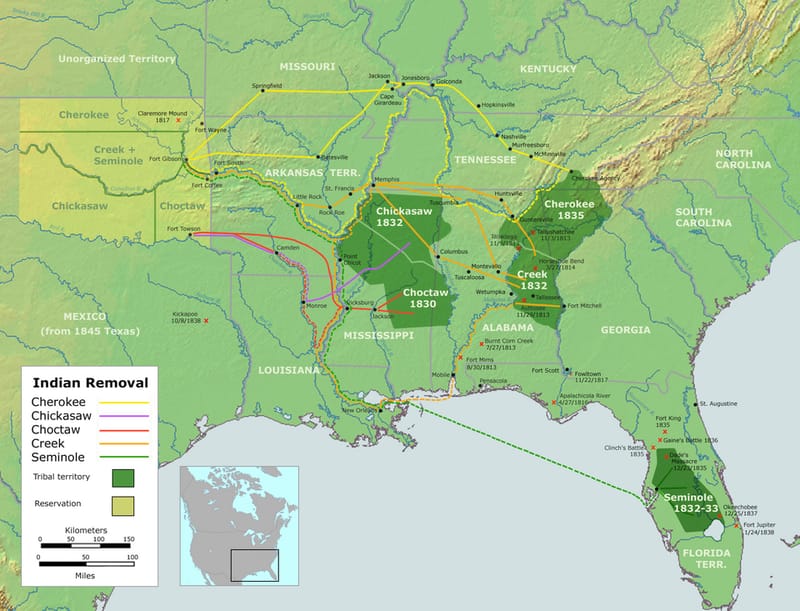
In 1838 federal troops and state militia forced about 16,000 Cherokee people from their homes in the Southeast into stockades, then sent them west to Indian Territory. Traveling by water and over land through the fall and winter of 1838–39, they suffered from disease, exposure, and hunger. About 4,000 died. The Trail of Tears has become the most widely known symbol of Indian removal.
Key facts
- Date
- May 1838 – March 1839
- Location
- From the Cherokee homeland in Georgia, Tennessee, North Carolina, and Alabama to Indian Territory (Oklahoma)
- Dating note
- The roundup began in May 1838; most groups traveled in the fall and winter of 1838–39.
- Legal basis
- The Treaty of New Echota (1835), signed by a small minority and ratified by the Senate by one vote in 1836
- People removed
- About 16,000 Cherokee
- Deaths
- About 4,000
- Distance
- As many as 1,000 miles; most overland parties walked about 800 miles
- Cherokee leader
- Principal Chief John Ross, who opposed the treaty
Why it matters
The Trail of Tears is remembered as one of the clearest moral failures in American history — the forced expulsion of a nation that had done everything asked of it, carried out by the government sworn to protect its treaty rights.
Historical background
The Cherokee had lived for centuries in the southern Appalachians. Under pressure from settlers, they ceded more than 90 percent of their lands between 1721 and 1819. They adapted in ways many Americans demanded — farming, trading, building a written legal system and constitution, and, through Sequoyah’s syllabary, achieving widespread literacy. None of this protected them. When gold was found on Cherokee land in 1830, the same year as the Indian Removal Act, Georgia held lotteries giving Cherokee land and gold rights to whites and passed laws stripping the Cherokee of the right to govern themselves or testify in court against whites.
Causes and contributing factors
The Cherokee fought removal through the courts and won: in Worcester v. Georgia (1832), the Supreme Court held that Georgia’s laws had no force in the Cherokee Nation. But President Jackson refused to enforce the decision. Most Cherokee, led by Principal Chief John Ross, opposed removal; a minority concluded that resistance was futile and that a treaty was the only way to survive as a people. In December 1835, U.S. officials met with this minority at New Echota, Georgia. Only 300 to 500 Cherokee were present and none were elected officials, yet twenty signed a treaty ceding all Cherokee land east of the Mississippi for $5 million and new land in the West. More than 15,000 Cherokee protested. The Senate ratified the treaty on May 23, 1836, by a single vote.
What happened
Most Cherokee refused to believe they would be forced out. In May 1838, General Winfield Scott, with 3,000 troops and authority to raise more, began rounding them up into stockades. Despite orders to treat them humanely, families were separated, the old and sick forced out at gunpoint, and homes looted as their owners were led away. Three groups left that summer, mostly by water, but low rivers, drought, and disease brought several deaths a day. The Cherokee asked to delay removal until fall and to conduct it themselves; the request was granted, but they had to wait in crowded internment camps.
By November, twelve groups of about 1,000 each were moving overland, roughly 800 miles. Autumn rains turned roads to mud, food was scarce, and two-thirds of the travelers were trapped between the ice-bound Ohio and Mississippi Rivers in January. One survivor remembered losing his father, then his mother, then his five brothers and sisters: “One each day. Then all are gone.”
Immediate consequences
Approximately 4,000 of 16,000 Cherokee died in the stockades or on the way. In Indian Territory, the survivors rebuilt their nation and government, but the bitter division between the treaty signers and the majority who had opposed removal lasted for years.
Long-term significance
The Trail of Tears stands for the human cost of a national policy that sacrificed treaty promises and a Supreme Court ruling to the demand for land. The routes are commemorated today as the Trail of Tears National Historic Trail, administered by the National Park Service.
Study this entry
Check your understanding
Try answering in your own words, then open the answer.
1.What led to the Trail of Tears?Show answerHide
The Cherokee fought removal through the courts and won: in Worcester v. Georgia (1832), the Supreme Court held that Georgia’s laws had no force in the Cherokee Nation. But President Jackson refused to enforce the decision.From “Causes and contributing factors” above.
2.What happened?Show answerHide
Most Cherokee refused to believe they would be forced out. In May 1838, General Winfield Scott, with 3,000 troops and authority to raise more, began rounding them up into stockades.From “What happened” above.
3.What were the immediate consequences?Show answerHide
Approximately 4,000 of 16,000 Cherokee died in the stockades or on the way. In Indian Territory, the survivors rebuilt their nation and government, but the bitter division between the treaty signers and the majority who had opposed removal lasted for years.From “Immediate consequences” above.
4.Why does it still matter?Show answerHide
The Trail of Tears stands for the human cost of a national policy that sacrificed treaty promises and a Supreme Court ruling to the demand for land. The routes are commemorated today as the Trail of Tears National Historic Trail, administered by the National Park Service.From “Long-term significance” above.
Turn this entry into 11 flashcards (key facts, dates, and why it matters) and review them in Learn.
Related History
How this connects to the rest of the atlas.
People

Sources
- 1.What Happened on the Trail of Tears?
National Park Service, Trail of Tears National Historic Trail · Institutional · cited for Cherokee history, Georgia laws, New Echota, roundup, routes, survivor testimony
- 2.President Andrew Jackson’s Message to Congress “On Indian Removal” (1830) — Milestone Documents
National Archives · Primary source · cited for New Echota, Scott’s troops, death toll
- 3.Trail of Tears — History & Culture
National Park Service, Trail of Tears National Historic Trail · Institutional · cited for overview of the trail
Image credits
- Trails of Tears en, User:Nikater, 2007-09-04. Via Wikimedia Commons · Public domain · Source
Written for American History Atlas from the sources above. See how entries are researched.
Atlas by Alexander. More on Telegram.