Sacagawea
The Lemhi Shoshone teenager who traveled with Lewis and Clark’s Corps of Discovery
c. 1788–c. 1812
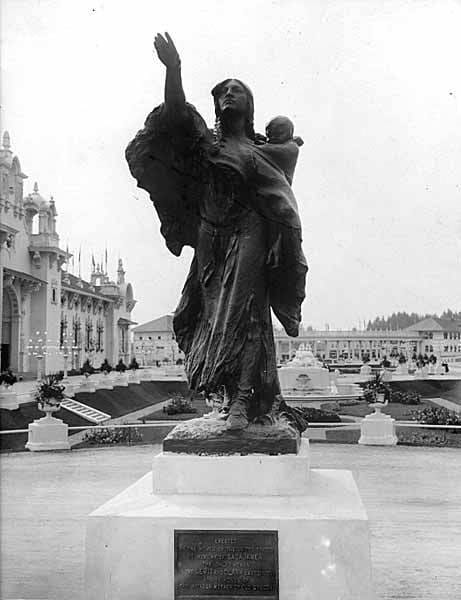
Sacagawea was a Lemhi Shoshone woman who, at sixteen or seventeen and carrying her newborn son, traveled with the Lewis and Clark Expedition on its journey west and back. The only woman in the Corps of Discovery, she is often remembered as its guide, but the expedition’s journals show something different and arguably more important: her presence told the tribes they met that the party was not a war party, and when the explorers reached her homeland in the Rockies, she helped them find the Shoshone and the horses they needed to cross the mountains.
Key facts
- Born
- c. 1788, Lemhi County, Idaho
- Died
- c. 1812, Fort Manuel Lisa
- Roles
- Member of the Corps of Discovery (1805–1806); Interpreter and intermediary
- People
- Lemhi Shoshone, from present-day Idaho
- Captured
- At about eleven or twelve, by a Hidatsa raiding party
- With the Corps
- Left the Mandan and Hidatsa villages in April 1805 with her two-month-old son
- Role
- The only woman in the expedition; interpreter with her husband, Toussaint Charbonneau
- Clark’s words
- “A woman with a party of men is a token of peace”
Why it matters
Sacagawea is one of the most commemorated women in American history and a reminder that the expedition depended on Native people. Her real story — a captive teenager and young mother whose presence and knowledge helped the Corps survive — is both more modest and more remarkable than the legend of the guide who led the way west.
Early life and context
Sacagawea was born around 1788 among the Lemhi Shoshone in the mountains of present-day Idaho. When she was about eleven or twelve, a Hidatsa raiding party captured her and carried her east to the Hidatsa villages on the Knife River in present-day North Dakota, where she lived at the Awatixa village. There she became one of the wives of Toussaint Charbonneau, a French-Canadian fur trader.
Major actions and achievements
Meriwether Lewis and William Clark met her at the Mandan and Hidatsa villages in 1804 and hired Charbonneau as an interpreter; Sacagawea came too, valued for her knowledge of the tribes and terrain farther west. In February 1805 she gave birth to her first child, a boy — Lewis noted that “one of the wives of Charbono was delivered of a fine boy” — and two months later she set out with the Corps, carrying him. On the journey she dug roots and found other food, and showed the men how to make leather clothing and moccasins. Her presence reassured the tribes they met; as Clark wrote, she “reconciles all the Indians, as to our friendly intentions. A woman with a party of men is a token of peace.”
When the expedition reached the Rocky Mountains, everything depended on finding the Shoshone and trading for horses, without which the explorers could not haul their supplies over the mountains. Recognizing landmarks from her childhood, Sacagawea assured the captains that her people were near. When they found the Shoshone, she translated along with her husband, and the Corps secured its horses.
Beliefs and ideas
Sacagawea left no written words of her own; what is known of her comes almost entirely from the journals of the expedition’s men, which record her actions rather than her thoughts.
Controversies, limits, and criticism
Popular legend made Sacagawea the guide who led Lewis and Clark across the continent, but the expedition journals offer little evidence of that; historians generally believe she joined because her husband was hired as an interpreter. Even basic facts are disputed. Her name is spelled several ways, and the Mandan, Hidatsa & Arikara Nation’s Sacagawea Project has published its own account, Our Eagle Woman, Sacagawea: They Got It Wrong, challenging the standard story. Accounts of her later life also differ.
Legacy
On the return journey in 1806, Sacagawea and her family left the Corps at the Mandan and Hidatsa villages. Little is known of her life afterward; most historians believe she died of a fever at Fort Manuel Lisa around 1812, when she was not yet thirty. Statues honor her, among them one in Portland, Oregon, and the National Park Service tells her story at Lewis and Clark sites from North Dakota to the Pacific.
Study this entry
Check your understanding
Try answering in your own words, then open the answer.
1.What shaped Sacagawea early in life?Show answerHide
Sacagawea was born around 1788 among the Lemhi Shoshone in the mountains of present-day Idaho. When she was about eleven or twelve, a Hidatsa raiding party captured her and carried her east to the Hidatsa villages on the Knife River in present-day North Dakota, where she lived at the Awatixa village.From “Early life and context” above.
2.What were Sacagawea’s major achievements?Show answerHide
Meriwether Lewis and William Clark met her at the Mandan and Hidatsa villages in 1804 and hired Charbonneau as an interpreter; Sacagawea came too, valued for her knowledge of the tribes and terrain farther west.From “Major actions and achievements” above.
3.What criticism or controversy surrounds Sacagawea?Show answerHide
Popular legend made Sacagawea the guide who led Lewis and Clark across the continent, but the expedition journals offer little evidence of that; historians generally believe she joined because her husband was hired as an interpreter. Even basic facts are disputed.From “Controversies, limits, and criticism” above.
4.How is Sacagawea remembered?Show answerHide
On the return journey in 1806, Sacagawea and her family left the Corps at the Mandan and Hidatsa villages. Little is known of her life afterward; most historians believe she died of a fever at Fort Manuel Lisa around 1812, when she was not yet thirty.From “Legacy” above.
Turn this entry into 11 flashcards (key facts, dates, and why it matters) and review them in Learn.
Related History
How this connects to the rest of the atlas.
Events
People
.jpg)
Sources
- 1.Sacagawea
National Park Service, Lewis and Clark National Historic Trail · Institutional · cited for capture, marriage, birth of her son, role in the expedition, Clark quotation, guide legend, death
- 2.Sacagawea
National Park Service · Institutional · cited for quick facts, Awatixa village, contributions, horses, death, MHA Nation scholarship
Image credits
- Sacagawea statue, Portland, 1905, Unknown photographer, 1905. Via Wikimedia Commons · Public domain · Source
Written for American History Atlas from the sources above. See how entries are researched.
Atlas by Alexander. More on Telegram.