EventWorld War II and the Early Cold War
The Marshall Plan
The European Recovery Program, 1948–1952
1948–1952Western Europe
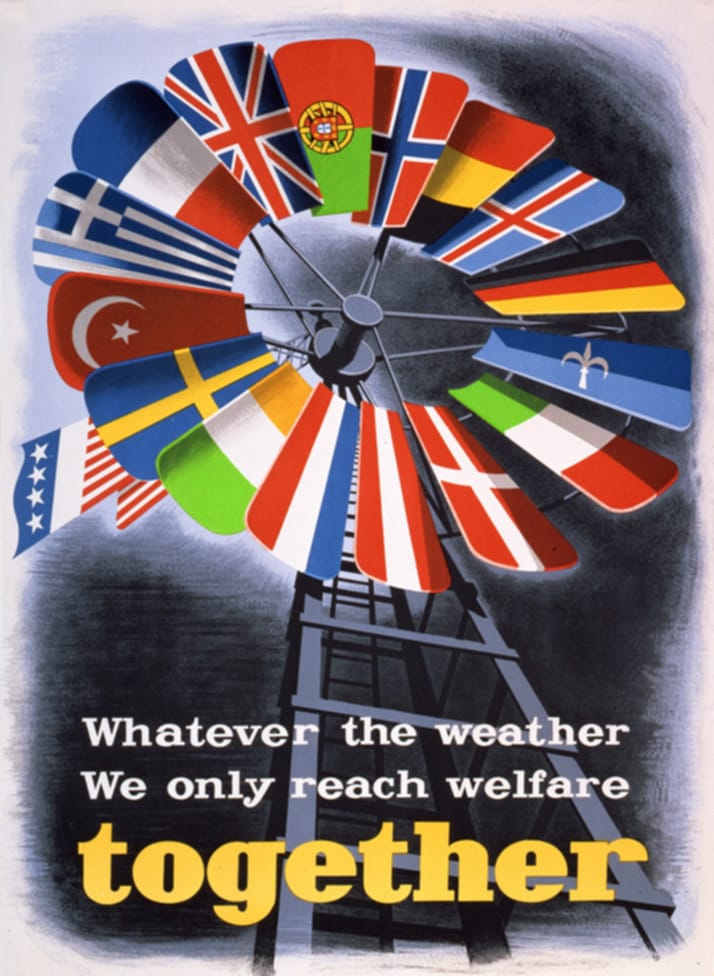
The Marshall Plan was a massive American program to rebuild the war-ravaged economies of Western Europe after World War II. Proposed by Secretary of State George C. Marshall in a June 1947 speech at Harvard, it provided more than $12 billion between 1948 and 1952. American leaders saw it as both a humanitarian effort and a way to stop the spread of communism by restoring prosperity. The Soviet Union refused to take part and kept its Eastern European satellites out, deepening the division of Europe.
Key facts
- Date
- 1948–1952
- Location
- Western Europe
- Dating note
- Proposed by Secretary of State George C. Marshall on June 5, 1947; Congress passed the Economic Cooperation Act in March 1948.
- Proposed
- June 5, 1947, commencement speech at Harvard University
- Law
- Economic Cooperation Act, March 1948
- Aid
- More than $12 billion to Western Europe
- Soviet response
- Refused to participate and barred Eastern European countries; offered its own “Molotov Plan”
- Recognition
- George Marshall received the Nobel Peace Prize
Why it matters
The Marshall Plan was one of the most ambitious and successful foreign policy initiatives in American history, binding Western Europe to the United States at the start of the Cold War.
Historical background
Two years after the war, much of Europe remained in ruins. The brutal winter of 1946–1947 halted coal production, closed factories, and brought famine close; communist parties in France and Italy won nearly a third of the seats in their parliaments. American officials feared that hunger and unemployment would make Western Europe vulnerable to communism.
Causes and contributing factors
Coming just months after the Truman Doctrine, Marshall’s proposal argued that the United States should help restore “normal economic health to the world, without which there can be no political stability and no assured peace.” He insisted the plan was directed “not against any country” but against hunger, poverty, and chaos. Congress, spurred by fear of communist expansion and Europe’s deteriorating economy, approved the Economic Cooperation Act in March 1948.
What happened
American aid poured into Western Europe for reconstruction while trade barriers were loosened. Participation by the Soviet Union and Eastern Europe was initially possible, but Stalin, suspicious of American economic domination and unwilling to open Soviet society to Westerners, refused. He saw the plan as a “Trojan Horse” and tightened his control over Eastern Europe; Poland, for instance, was rewarded with a Soviet trade agreement for boycotting the plan. The plan therefore went only to Western Europe.
Immediate consequences
The Marshall Plan fueled a resurgence of European industry and investment and created markets for American goods. Moscow viewed the revival of Western Europe — especially West Germany — with suspicion, and the plan contributed to the hardening division between East and West.
Long-term significance
Economic historians debate how much the Marshall Plan itself caused Europe’s recovery, but it is widely recognized as a great humanitarian effort. It established foreign aid as a permanent tool of American foreign policy and laid groundwork for European economic integration and the NATO alliance.
Study this entry
Check your understanding
Try answering in your own words, then open the answer.
1.What led to the Marshall Plan?Show answerHide
Coming just months after the Truman Doctrine, Marshall’s proposal argued that the United States should help restore “normal economic health to the world, without which there can be no political stability and no assured peace.”From “Causes and contributing factors” above.
2.What happened?Show answerHide
American aid poured into Western Europe for reconstruction while trade barriers were loosened. Participation by the Soviet Union and Eastern Europe was initially possible, but Stalin, suspicious of American economic domination and unwilling to open Soviet society to Westerners, refused.From “What happened” above.
3.What were the immediate consequences?Show answerHide
The Marshall Plan fueled a resurgence of European industry and investment and created markets for American goods. Moscow viewed the revival of Western Europe — especially West Germany — with suspicion, and the plan contributed to the hardening division between East and West.From “Immediate consequences” above.
4.Why does it still matter?Show answerHide
Economic historians debate how much the Marshall Plan itself caused Europe’s recovery, but it is widely recognized as a great humanitarian effort. It established foreign aid as a permanent tool of American foreign policy and laid groundwork for European economic integration and the NATO alliance.From “Long-term significance” above.
Turn this entry into 11 flashcards (key facts, dates, and why it matters) and review them in Learn.
Related History
How this connects to the rest of the atlas.
Wars

Sources
- 1.Marshall Plan, 1948
U.S. Department of State, Office of the Historian · Institutional · cited for Marshall Plan
- 2.The American Yawp, “The Cold War”
The American Yawp (eds. Joseph Locke and Ben Wright; Stanford University Press) · Scholarly · cited for containment, Marshall Plan, Berlin, NATO, NSC-68, Korea, McCarthyism, arms race
- 3.North Atlantic Treaty Organization (NATO), 1949
U.S. Department of State, Office of the Historian · Institutional · cited for NATO
Image credits
- Marshall Plan poster, E. Spreckmeester (also credited as "I. Spreekmeester"), published Economic Cooperation Administration, 1950. Via Wikimedia Commons · Public domain · Source
Written for American History Atlas from the sources above. See how entries are researched.
Atlas by Alexander. More on Telegram.