InstitutionCivil War and Reconstruction
The Freedmen’s Bureau
The federal agency that aided formerly enslaved people, 1865–1872
March 3, 1865 – 1872Headquarters in Washington, D.C.; offices throughout the South
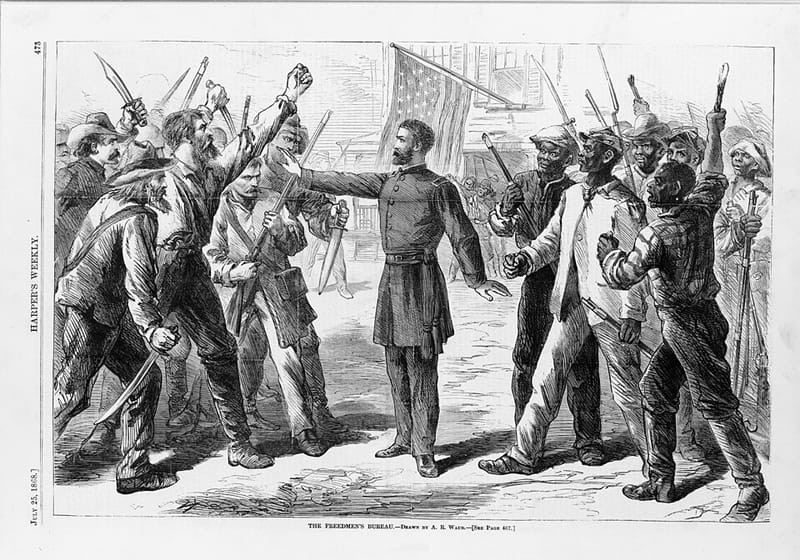
Officially the Bureau of Refugees, Freedmen, and Abandoned Lands, the Freedmen’s Bureau was created by Congress in March 1865 to help formerly enslaved people make the transition to freedom. Led by General Oliver O. Howard, it issued food and clothing, ran hospitals, supervised labor contracts, helped found schools, legalized marriages made in slavery, and helped families reunite. Underfunded and opposed by President Andrew Johnson and white Southerners, it did most of its work between 1865 and 1868 and closed in 1872.
Key facts
- Date
- March 3, 1865 – 1872
- Established
- March 3, 1865
- Location
- Headquarters in Washington, D.C.; offices throughout the South
- Created
- March 3, 1865, in the War Department
- Commissioner
- Maj. Gen. Oliver Otis Howard
- Main activity
- June 1865 – December 1868
- Abolished
- 1872
- Records
- National Archives Record Group 105 — a key source for African American genealogy
Why it matters
The Freedmen’s Bureau was the federal government’s first large social welfare agency, and its schools helped launch Black education in the South, even as its limited power showed how little the nation was prepared to invest in freedom.
Origins
During the war, Union commanders and Treasury officials handled the needs of refugees and freedpeople and the management of abandoned and confiscated land. Congress consolidated those duties on March 3, 1865, creating the Bureau in the War Department. In May, President Andrew Johnson appointed Maj. Gen. Oliver Otis Howard as commissioner, with assistant commissioners in each Southern state.
Powers and limits
The Bureau’s mission was to provide relief and help freedpeople become self-sufficient. It issued rations and clothing, operated hospitals and refugee camps, supervised labor contracts between planters and freedpeople, handled complaints and apprenticeship disputes, assisted benevolent societies in founding schools, helped legalize marriages entered into during slavery, and provided transportation to people trying to reunite with family or relocate. Later it also helped Black veterans obtain back pay and bounties.
How it changed over time
Congress passed a new Freedmen’s Bureau bill in 1866 in the face of President Johnson’s opposition; Johnson had allowed Southern states to pass black codes that essentially maintained slavery under another name. Most of the Bureau’s work ended by December 1868, and it was abolished in 1872. Its records — letters, labor contracts, marriage registers, and school reports — are now among the richest sources on the lives of African Americans in the first years of freedom.
Study this entry
Check your understanding
Try answering in your own words, then open the answer.
1.Where did it come from?Show answerHide
During the war, Union commanders and Treasury officials handled the needs of refugees and freedpeople and the management of abandoned and confiscated land. Congress consolidated those duties on March 3, 1865, creating the Bureau in the War Department.From “Origins” above.
2.What can it do, and what limits it?Show answerHide
The Bureau’s mission was to provide relief and help freedpeople become self-sufficient.From “Powers and limits” above.
3.How has it changed over time?Show answerHide
Congress passed a new Freedmen’s Bureau bill in 1866 in the face of President Johnson’s opposition; Johnson had allowed Southern states to pass black codes that essentially maintained slavery under another name. Most of the Bureau’s work ended by December 1868, and it was abolished in 1872.From “How it changed over time” above.
Turn this entry into 10 flashcards (key facts, dates, and why it matters) and review them in Learn.
Related History
How this connects to the rest of the atlas.
Events

Sources
- 1.Freedmen’s Bureau Records
National Archives · Institutional · cited for creation, duties, duration
- 2.Andrew Johnson: Life in Brief
Miller Center, University of Virginia · Scholarly · cited for presidential Reconstruction, black codes, impeachment, Black officeholders
Image credits
- The Freedmen's Bureau - Drawn by A.R. Waud. LCCN92514996, Waud, Alfred R. (Alfred Rudolph), 1828-1891, artist, 1868. Via Wikimedia Commons · Public domain · Source
Written for American History Atlas from the sources above. See how entries are researched.
Atlas by Alexander. More on Telegram.