Court CaseCivil Rights and Social Transformation
United States v. Nixon
The Supreme Court orders the president to release the Watergate tapes
1974Washington, D.C.
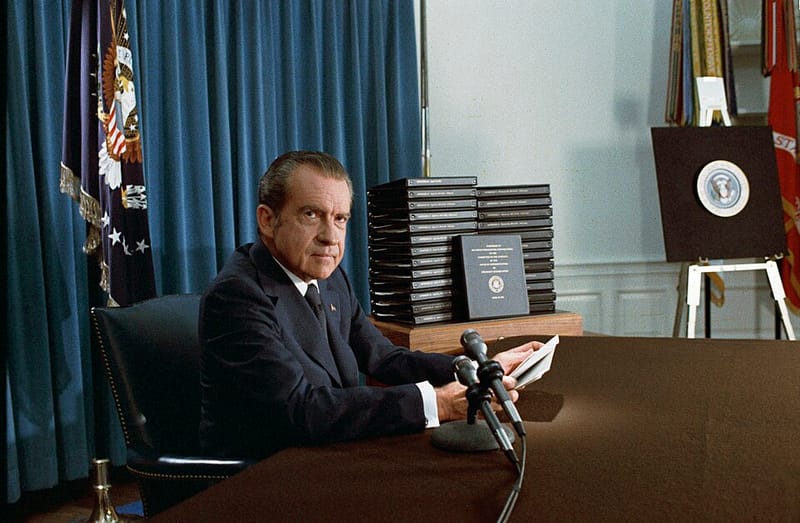
In United States v. Nixon, decided July 24, 1974, the Supreme Court unanimously rejected President Richard Nixon’s claim that “executive privilege” allowed him to withhold White House tape recordings subpoenaed in the Watergate prosecutions. The Court recognized a limited privilege but held that it must yield to the needs of the criminal justice system. The tapes Nixon was forced to release led to his resignation sixteen days later.
Key facts
- Citation
- 418 U.S. 683 (1974)
- Decided
- July 24, 1974
- Vote
- 8–0
- Majority opinion
- Chief Justice Warren Burger
- Location
- Washington, D.C.
- Decided
- July 24, 1974
- Vote
- 8–0 (Justice William Rehnquist did not participate)
- Opinion
- Chief Justice Warren Burger
- Issue
- Executive privilege vs. a criminal trial subpoena
- Result
- Nixon released the tapes and resigned August 9, 1974
Why it matters
United States v. Nixon affirmed that no one, including the president, is beyond the reach of the courts.
Historical context
A grand jury indicted seven of Nixon’s closest aides in the Watergate affair. The special prosecutor, Leon Jaworski, subpoenaed recordings of Oval Office conversations. Nixon refused, claiming executive privilege — the right to keep confidential communications within the executive branch — and argued the courts had no power to review his claim.
The legal question
Is the president’s executive privilege entirely immune from judicial review?
The ruling
No. The Court held that neither the separation of powers nor the general need for confidentiality could sustain an absolute, unqualified presidential privilege in the face of a criminal subpoena. Nixon had to produce the tapes.
The Court’s reasoning
The Court acknowledged a limited privilege, strongest in military and diplomatic matters, but gave priority to “the fundamental demands of due process of law in the fair administration of justice.” A generalized claim of confidentiality could not override the need for evidence in a criminal trial, and it was the courts’ role to decide such questions.
Consequences
The released tapes included the June 1972 “smoking gun” conversation in which Nixon approved using the CIA to obstruct the FBI investigation. His political support collapsed, and he resigned on August 9, 1974.
Later interpretation
How later courts, scholars, and the public have judged the case — not part of the ruling itself.
The case established that the president is not above the law and that claims of executive privilege are subject to judicial review.
Study this entry
Check your understanding
Try answering in your own words, then open the answer.
1.What question did the Court have to answer?Show answerHide
Is the president’s executive privilege entirely immune from judicial review?From “The legal question” above.
2.What did the Court decide?Show answerHide
No. The Court held that neither the separation of powers nor the general need for confidentiality could sustain an absolute, unqualified presidential privilege in the face of a criminal subpoena. Nixon had to produce the tapes.From “The ruling” above.
3.How did the Court justify its decision?Show answerHide
The Court acknowledged a limited privilege, strongest in military and diplomatic matters, but gave priority to “the fundamental demands of due process of law in the fair administration of justice.”From “The Court’s reasoning” above.
4.What were the consequences?Show answerHide
The released tapes included the June 1972 “smoking gun” conversation in which Nixon approved using the CIA to obstruct the FBI investigation. His political support collapsed, and he resigned on August 9, 1974.From “Consequences” above.
Turn this entry into 10 flashcards (key facts, dates, and why it matters) and review them in Learn.
Related History
How this connects to the rest of the atlas.


Sources
- 1.United States v. Nixon
Oyez (Cornell LII, Justia, Chicago-Kent College of Law) · Scholarly · cited for facts, question, holding, vote
- 2.Richard Nixon: Domestic Affairs
Miller Center, University of Virginia · Scholarly · cited for environmental policy, Watergate, resignation
- 3.The American Yawp, “The Unraveling”
The American Yawp (eds. Joseph Locke and Ben Wright; Stanford University Press) · Scholarly · cited for 1970s: Vietnam’s end, Watergate, feminism, environmentalism
Image credits
- Nixon edited transcripts, National Archives & Records Administration, 1974-04-29. Via Wikimedia Commons · Public domain · Source
Written for American History Atlas from the sources above. See how entries are researched.
Atlas by Alexander. More on Telegram.