EventThe Progressive Era and World War I
The Triangle Shirtwaist Factory Fire
A disaster that changed American workplace safety, March 25, 1911
March 25, 1911Asch Building, Greenwich Village, New York City
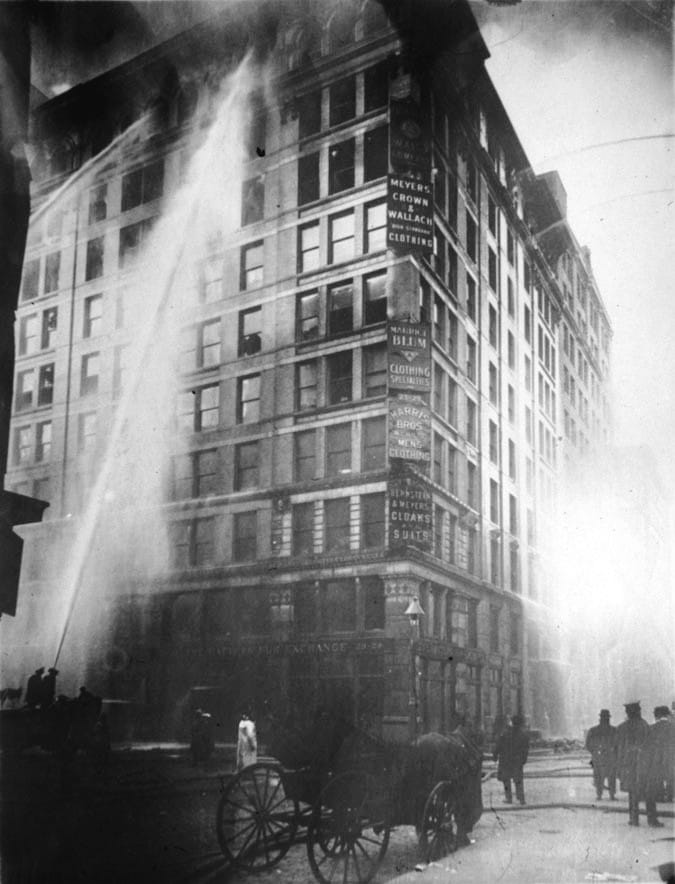
Near closing time on March 25, 1911, fire swept the top floors of the Asch Building in New York City, where the Triangle Waist Company employed some 500 workers — mostly young Italian and Jewish immigrant women, some only fourteen. Trapped behind doors workers believed were locked, with a fire escape that collapsed and ladders that could not reach them, 146 died, many leaping from the windows. The owners were acquitted of manslaughter, but public outrage drove a wave of workplace safety reforms.
Key facts
- Date
- March 25, 1911
- Location
- Asch Building, Greenwich Village, New York City
- Date
- Saturday, March 25, 1911
- Deaths
- 146 of about 500 employees
- Workers
- Mostly young Italian and Eastern European Jewish immigrant women
- Trial
- Owners Max Blanck and Isaac Harris acquitted of manslaughter in December 1911; later paid $75 per life lost in a civil settlement
Why it matters
The Triangle fire turned the dangers of industrial work into a public scandal and remains one of the most important catalysts for workplace safety reform in American history.
Historical background
New York’s garment industry was built on low wages, long hours, and crowded, dangerous loft factories. Workers — many of them recent immigrants struggling with a new language — risked their jobs if they complained. A year before the fire, Triangle workers had struck for union recognition, higher wages, and better safety conditions; the shop remained non-union.
Causes and contributing factors
Fire inspections and precautions were woefully inadequate. Owners frequently locked exit doors, claiming workers stole materials. The building’s fire escape was flimsy, and fire department ladders reached only a few floors up.
What happened
A fire broke out near closing time on the top floors of the ten-story building. Workers on the ninth floor struggled to open doors to the stairs; they and many others believed the doors had been deliberately locked. The single fire escape bent and collapsed under the weight of those trying to escape. Firefighters’ ladders were several stories too short, and their hoses could not reach the top floors. Many workers jumped to their deaths in front of horrified crowds rather than burn. By the end, 146 were dead and 71 injured.
Immediate consequences
Mourning and protest followed; the labor organizer Rose Schneiderman, a former Triangle worker, declared that “the life of men and women is so cheap and property is so sacred.” The owners, Max Blanck and Isaac Harris, were tried for manslaughter, but on December 27, 1911, the jury acquitted them because it could not be proven they knew the doors were locked. In a civil settlement they paid $75 per life lost. Blanck was later fined just $20 for locking a door at another factory.
Long-term significance
The fire exposed the inhumane conditions industrial workers could face and became a rallying point for labor and reform movements. As The American Yawp puts it, events such as the Triangle fire convinced many Americans of the need for reform and for government intervention in the economy — central aims of the Progressive movement. The victims are still remembered as martyrs of the labor movement.
Study this entry
Check your understanding
Try answering in your own words, then open the answer.
1.What led to the Triangle Shirtwaist Factory Fire?Show answerHide
Fire inspections and precautions were woefully inadequate. Owners frequently locked exit doors, claiming workers stole materials.From “Causes and contributing factors” above.
2.What happened?Show answerHide
A fire broke out near closing time on the top floors of the ten-story building. Workers on the ninth floor struggled to open doors to the stairs; they and many others believed the doors had been deliberately locked.From “What happened” above.
3.What were the immediate consequences?Show answerHide
Mourning and protest followed; the labor organizer Rose Schneiderman, a former Triangle worker, declared that “the life of men and women is so cheap and property is so sacred.”From “Immediate consequences” above.
4.Why does it still matter?Show answerHide
The fire exposed the inhumane conditions industrial workers could face and became a rallying point for labor and reform movements.From “Long-term significance” above.
Turn this entry into 10 flashcards (key facts, dates, and why it matters) and review them in Learn.
Related History
How this connects to the rest of the atlas.
Movements

Sources
- 1.The Triangle Factory Fire — Story of the Fire
Kheel Center, Cornell University ILR School · Scholarly · cited for date, deaths, locked doors, conditions
- 2.The Triangle Factory Fire — Investigation & Trial
Kheel Center, Cornell University ILR School · Scholarly · cited for trial, acquittal, settlement
- 3.The Triangle Factory Fire — Introduction
Kheel Center, Cornell University ILR School · Scholarly · cited for significance
- 4.The American Yawp, “The Progressive Era”
The American Yawp (eds. Joseph Locke and Ben Wright; Stanford University Press) · Scholarly · cited for Progressivism, muckrakers, Addams, Triangle fire, suffrage
Image credits
- Image of Triangle Shirtwaist Factory fire on March 25 - 1911, Unknown author Unknown author, March 25, 1911 First published on front . Via Wikimedia Commons · Public domain · Source
Written for American History Atlas from the sources above. See how entries are researched.
Atlas by Alexander. More on Telegram.