EventIndustrialization and the Gilded Age
The Haymarket Affair
A bomb at a Chicago labor rally, May 4, 1886
May 4, 1886Haymarket Square, Chicago, Illinois
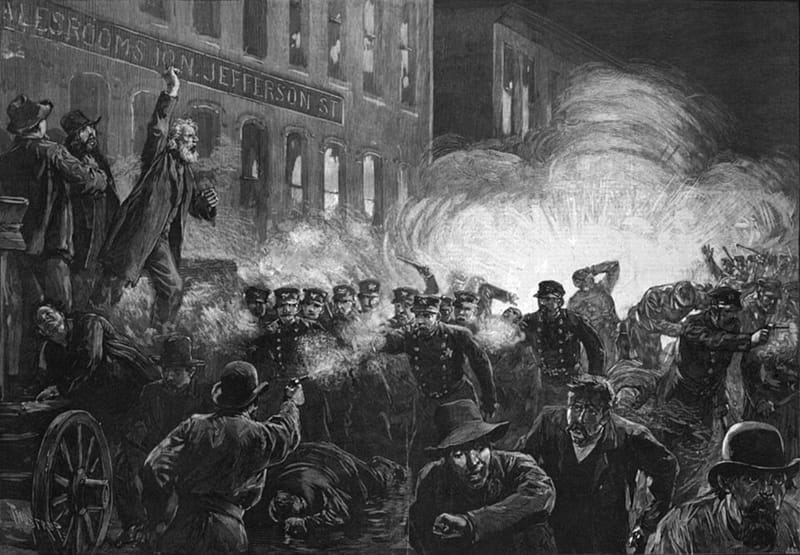
On May 4, 1886, about 1,500 workers rallied near Chicago’s Haymarket Square to protest police violence against strikers the day before, during a nationwide campaign for the eight-hour day. As police moved to disperse the crowd, someone threw a bomb; police and possibly others opened fire. Seven police officers and at least one civilian died. Eight anarchists were convicted of murder on little evidence linking them to the bomb; four were hanged. The affair set off a wave of anti-labor and anti-immigrant fear.
Key facts
- Date
- May 4, 1886
- Location
- Haymarket Square, Chicago, Illinois
- Date
- May 4, 1886
- Deaths
- Seven police officers and at least one civilian; at least 60 wounded
- Trial
- Eight men convicted August 20, 1886; seven sentenced to death
- Executions
- Four hanged November 11, 1887; one died by suicide; three later pardoned (1893)
Why it matters
Haymarket became a symbol of the bitter conflict between labor and capital in the Gilded Age — and of how fear of radicalism could override due process.
Historical background
In the 1880s strikes spread as workers protested long hours and low wages, and unions launched a national campaign for the eight-hour day, centered on May 1, 1886. Chicago, a fast-growing industrial and immigrant city, was a center of both the labor movement and radical anarchist politics.
Causes and contributing factors
On May 3, police fired on strikers at the McCormick Harvesting Machine Company, leaving one man dead and many injured. Labor activists called a protest rally for the next evening.
What happened
On May 4 at 7:30 p.m., around 1,500 people gathered on Desplaines Street near Haymarket Square. Chicago’s mayor, Carter Harrison, attended as an observer and confirmed the meeting was peaceful. As the rally wound down and the mayor left, police arrived to disperse the remaining crowd. Someone threw a bomb. Chaos followed as police, and possibly some in the crowd, opened fire. Seven police officers and at least one civilian died, and at least sixty were wounded. The bomb thrower was never identified.
Immediate consequences
Eight men — the “Chicago Eight,” known for their anarchist politics and pro-labor activism — were charged with murder, though some had not even attended the rally and little evidence connected them to the bomb. On August 20, 1886, a jury found them guilty, and Judge Joseph E. Gary sentenced seven to death. Two sentences were commuted to life imprisonment; Louis Lingg killed himself in his cell; and on November 11, 1887, Adolph Fischer, George Engel, Albert Parsons, and August Spies were hanged. In 1893 Illinois Governor John P. Altgeld pardoned the three surviving defendants.
Long-term significance
The affair set off a wave of xenophobia and anti-labor sentiment in Chicago and across the country, damaging the Knights of Labor and the eight-hour movement as many Americans associated labor activism with violence and foreign radicals. To many workers at home and abroad, the executed men became martyrs.
Study this entry
Check your understanding
Try answering in your own words, then open the answer.
1.What led to the Haymarket Affair?Show answerHide
On May 3, police fired on strikers at the McCormick Harvesting Machine Company, leaving one man dead and many injured. Labor activists called a protest rally for the next evening.From “Causes and contributing factors” above.
2.What happened?Show answerHide
On May 4 at 7:30 p.m., around 1,500 people gathered on Desplaines Street near Haymarket Square. Chicago’s mayor, Carter Harrison, attended as an observer and confirmed the meeting was peaceful.From “What happened” above.
3.What were the immediate consequences?Show answerHide
Eight men — the “Chicago Eight,” known for their anarchist politics and pro-labor activism — were charged with murder, though some had not even attended the rally and little evidence connected them to the bomb. On August 20, 1886, a jury found them guilty, and Judge Joseph E. Gary sentenced seven to death.From “Immediate consequences” above.
4.Why does it still matter?Show answerHide
The affair set off a wave of xenophobia and anti-labor sentiment in Chicago and across the country, damaging the Knights of Labor and the eight-hour movement as many Americans associated labor activism with violence and foreign radicals. To many workers at home and abroad, the executed men became martyrs.From “Long-term significance” above.
Turn this entry into 9 flashcards (key facts, dates, and why it matters) and review them in Learn.
Related History
How this connects to the rest of the atlas.
Documents
Movements

Sources
- 1.“Prepare for the Stormy Times Before Us”: Chicago’s Haymarket Affair
University of Illinois Library, Illinois History and Lincoln Collections · Scholarly · cited for rally, bombing, trial, executions, pardons
- 2.The American Yawp, “Capital and Labor”
The American Yawp (eds. Joseph Locke and Ben Wright; Stanford University Press) · Scholarly · cited for Gilded Age, labor organizing, strikes
Image credits
- HaymarketRiot-Harpers, Thure de Thulstrup, 1886-05-15. Via Wikimedia Commons · Public domain · Source
Written for American History Atlas from the sources above. See how entries are researched.
Atlas by Alexander. More on Telegram.