Court CaseThe Progressive Era and World War I
Schenck v. United States
Free speech in wartime and the “clear and present danger” test, 1919
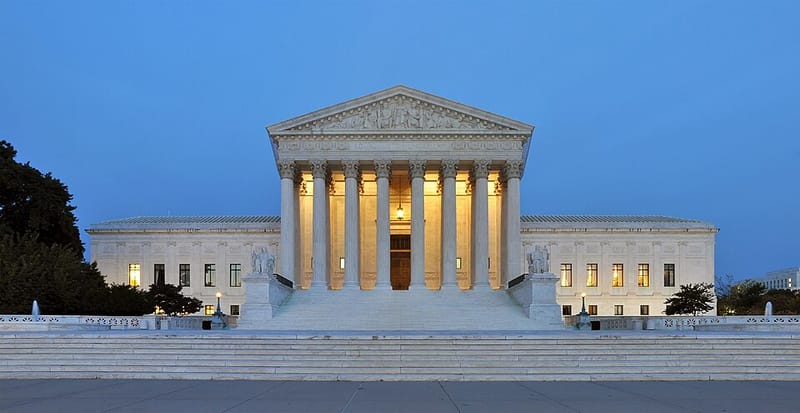
1919Washington, D.C.
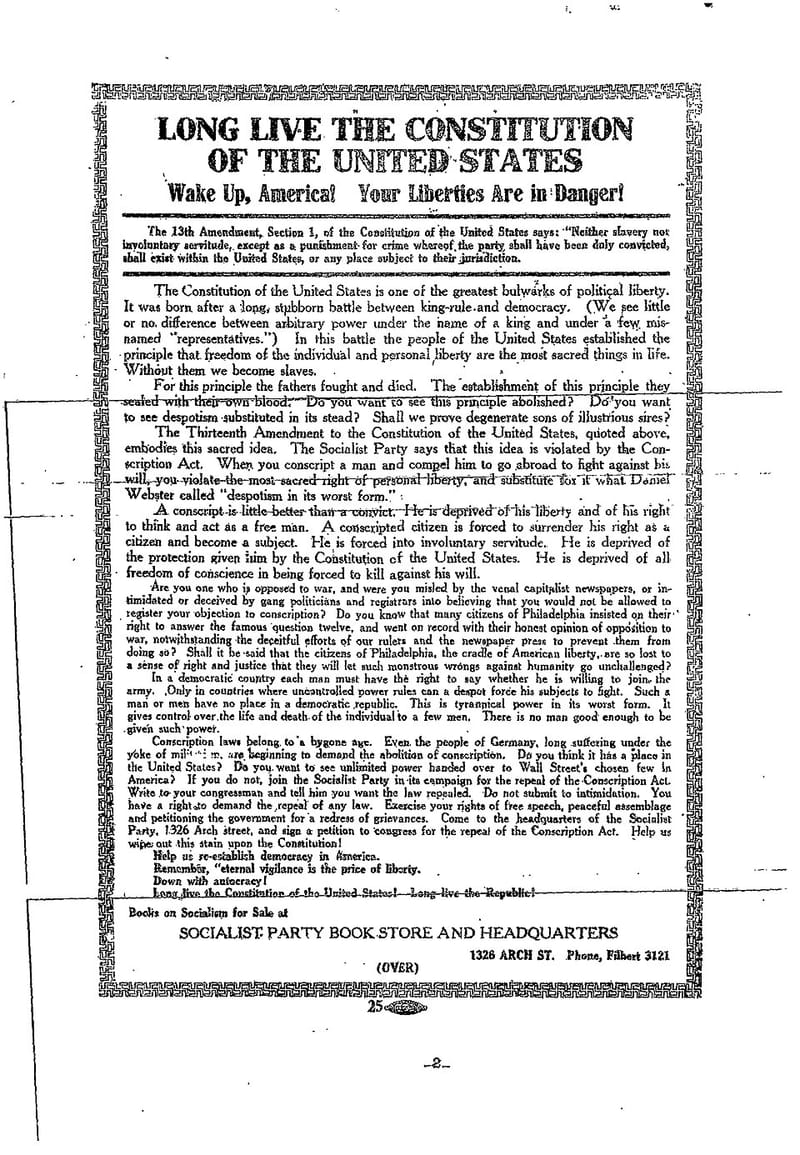
During World War I, socialists Charles Schenck and Elizabeth Baer mailed leaflets urging men to resist the draft, which they called involuntary servitude. Convicted under the Espionage Act, they argued that the law violated the First Amendment. In 1919 a unanimous Supreme Court upheld their convictions. Justice Oliver Wendell Holmes introduced the “clear and present danger” test and compared their leaflets to falsely shouting “fire” in a crowded theater.
Key facts
- Citation
- 249 U.S. 47 (1919)
- Decided
- March 3, 1919
- Vote
- 9–0
- Majority opinion
- Justice Oliver Wendell Holmes Jr.
- Location
- Washington, D.C.
- Law
- Espionage Act of 1917
- Defendants
- Charles Schenck and Elizabeth Baer, Socialist Party officials
- Test announced
- “Clear and present danger”
- Later fate
- Narrowed in later decisions, especially Brandenburg v. Ohio (1969)
Why it matters
Schenck was the Supreme Court’s first major ruling on the limits of free speech, and the debate it started over speech in times of crisis continues today.
Historical context
When the United States entered World War I in 1917, the Wilson administration sponsored the Espionage and Sedition Acts, which outlawed criticism of the government, the armed forces, and the war effort. The government imprisoned or fined violators and even censored or banned mainstream publications. Schenck and Baer, of the Socialist Party in Philadelphia, distributed leaflets declaring that the draft violated the Thirteenth Amendment’s ban on involuntary servitude and urging the public to oppose it — though by peaceful means.
The legal question
Did Schenck’s conviction under the Espionage Act for distributing leaflets opposing the draft violate his First Amendment right to freedom of speech?
The ruling
No. The Court unanimously held that the Espionage Act, as applied, did not violate the First Amendment and was an appropriate exercise of Congress’s wartime authority.
The Court’s reasoning
Justice Holmes reasoned that the character of every act depends on the circumstances, and that courts owe greater deference to the government in wartime. Articulating the “clear and present danger” test for the first time, he concluded that the First Amendment does not protect speech that creates a clear and present danger of bringing about substantive evils that Congress has the power to prevent. The widespread distribution of the leaflets, he reasoned, was sufficiently likely to obstruct recruitment. Free speech, he wrote, would not protect a man falsely shouting fire in a theater and causing a panic.
Consequences
Schenck upheld the government’s wartime prosecutions of dissenters, including socialists and pacifists. Within months, in Abrams v. United States (1919), Holmes himself dissented from another conviction, beginning to reinterpret the test as more protective of speech.
Later interpretation
How later courts, scholars, and the public have judged the case — not part of the ruling itself.
The “clear and present danger” test shaped free-speech law for half a century. In Brandenburg v. Ohio (1969), the Court adopted a more protective standard: speech can be punished only if it is “directed at inciting or producing imminent lawless action” and is likely to produce it. Holmes’s “shouting fire in a crowded theater” line is still widely quoted, often as if it stated current law, though the decision that coined it has been superseded.
Study this entry
Check your understanding
Try answering in your own words, then open the answer.
1.What question did the Court have to answer?Show answerHide
Did Schenck’s conviction under the Espionage Act for distributing leaflets opposing the draft violate his First Amendment right to freedom of speech?From “The legal question” above.
2.What did the Court decide?Show answerHide
No. The Court unanimously held that the Espionage Act, as applied, did not violate the First Amendment and was an appropriate exercise of Congress’s wartime authority.From “The ruling” above.
3.How did the Court justify its decision?Show answerHide
Justice Holmes reasoned that the character of every act depends on the circumstances, and that courts owe greater deference to the government in wartime.From “The Court’s reasoning” above.
4.What were the consequences?Show answerHide
Schenck upheld the government’s wartime prosecutions of dissenters, including socialists and pacifists. Within months, in Abrams v. United States (1919), Holmes himself dissented from another conviction, beginning to reinterpret the test as more protective of speech.From “Consequences” above.
Turn this entry into 9 flashcards (key facts, dates, and why it matters) and review them in Learn.
Related History
How this connects to the rest of the atlas.
.jpg)
Sources
- 1.Schenck v. United States
Oyez (Cornell LII, Justia, Chicago-Kent College of Law) · Scholarly · cited for facts, question, holding, clear and present danger
- 2.Woodrow Wilson: Life in Brief
Miller Center, University of Virginia · Scholarly · cited for life, New Freedom, segregation, WWI, Fourteen Points, treaty fight
- 3.Abrams v. United States
Oyez (Cornell LII, Justia, Chicago-Kent College of Law) · Scholarly · cited for Holmes’s dissent in Abrams
- 4.Brandenburg v. Ohio
Oyez (Cornell LII, Justia, Chicago-Kent College of Law) · Scholarly · cited for the imminent lawless action test
Image credits
- Schenck v. United States Leaflet (Obverse), Supreme Court of the United States, 1918-05-03. Via Wikimedia Commons · Public domain · Source
Written for American History Atlas from the sources above. See how entries are researched.
Atlas by Alexander. More on Telegram.