The First Great Awakening
A wave of evangelical revivals across the colonies, 1730s–1770s
1730s – 1770sThroughout British North America
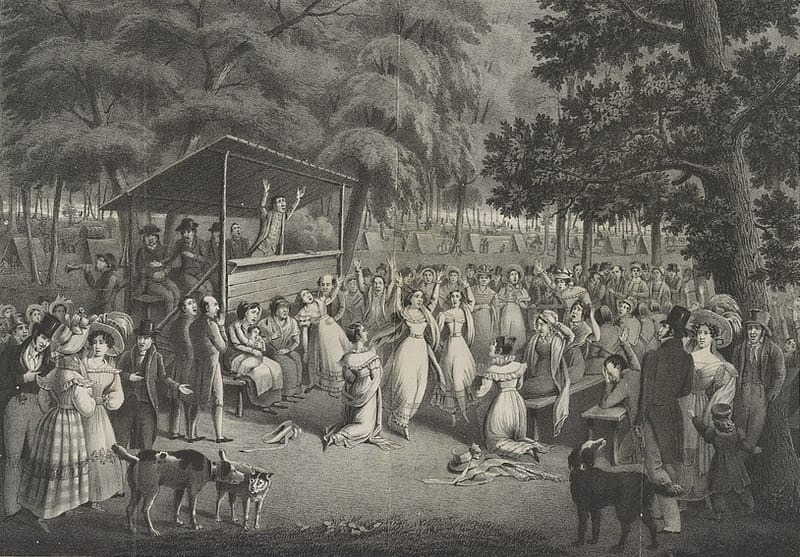
The First Great Awakening was a surge of evangelical Protestant revival that swept the American colonies from the 1730s to the 1770s, part of a movement also stirring Britain and Germany. Fiery preachers such as Jonathan Edwards and the traveling English evangelist George Whitefield urged listeners to experience a heartfelt conversion. The revivals split churches, challenged the authority of established clergy, and gave many colonists — including women and African Americans — new religious voices.
Key facts
- Date
- 1730s – 1770s
- Location
- Throughout British North America
- Dating note
- Historians date the revival from the 1730s to the 1770s; it peaked in the 1740s.
- Began
- 1730s, among Presbyterians in Pennsylvania and New Jersey, led by the Tennent family
- Famous preachers
- Gilbert Tennent, Jonathan Edwards, George Whitefield
- Best-known sermon
- Jonathan Edwards, “Sinners in the Hands of an Angry God”
- Divisions
- “New Lights” (supporters) vs. “Old Lights” (opponents)
Why it matters
The Great Awakening was the first movement to touch nearly every colony, and it left American Protestantism more diverse, more democratic in style, and deeply divided over religious authority.
Goals
Revivalists sought to awaken what they saw as spiritually complacent congregations. They taught that sinners were totally dependent on God’s grace for salvation and that true religion was felt in the heart, not merely reasoned in the head — a reaction against the rationalism of the Enlightenment.
Strategies
Preachers delivered emotionally charged, often extemporaneous sermons. The Tennents founded a seminary, the “Log College,” to train ministers in this style; its successor institution became Princeton University. George Whitefield, an ordained Anglican, made several trips across the Atlantic after 1739 and preached in every colony, often outdoors to crowds too large for any church — so famous that he was perhaps the only public figure whose name nearly all colonists knew. Itinerant preachers carried the revival from the Middle Colonies to New England and, by the 1740s and 1750s, to the South.
Opposition
Conservative and moderate clergy criticized the revivals’ emotionalism and the disorder that followed them. They especially objected to itinerants who criticized local ministers, and to white women and African Americans who stepped beyond their subordinate status to exhort religious gatherings. Congregations and whole denominations split.
Achievements
Baptists and, later, Methodists grew rapidly; by the eve of the Revolution, evangelical converts made up about a tenth of Southern churchgoers. The revivals encouraged ordinary people to judge religious authority for themselves, and dissenting churches lobbied to end the official, tax-supported status of the Congregational church in New England and the Anglican church in the South.
Unresolved questions
Historians debate how far the Awakening prepared the ground for the Revolution. Its challenge to established authority and its intercolonial reach suggest connections, but the links are indirect. Its most lasting legacy may be the evangelical style — revivals, conversion, voluntary churches — that became central to American religion.
Study this entry
Check your understanding
Try answering in your own words, then open the answer.
1.What did the movement want?Show answerHide
Revivalists sought to awaken what they saw as spiritually complacent congregations. They taught that sinners were totally dependent on God’s grace for salvation and that true religion was felt in the heart, not merely reasoned in the head — a reaction against the rationalism of the Enlightenment.From “Goals” above.
2.How did it pursue its goals?Show answerHide
Preachers delivered emotionally charged, often extemporaneous sermons. The Tennents founded a seminary, the “Log College,” to train ministers in this style; its successor institution became Princeton University.From “Strategies” above.
3.Who opposed it, and how?Show answerHide
Conservative and moderate clergy criticized the revivals’ emotionalism and the disorder that followed them. They especially objected to itinerants who criticized local ministers, and to white women and African Americans who stepped beyond their subordinate status to exhort religious gatherings.From “Opposition” above.
4.What did it achieve?Show answerHide
Baptists and, later, Methodists grew rapidly; by the eve of the Revolution, evangelical converts made up about a tenth of Southern churchgoers.From “Achievements” above.
Turn this entry into 10 flashcards (key facts, dates, and why it matters) and review them in Learn.
Related History
How this connects to the rest of the atlas.
Events
People

Sources
- 1.The First Great Awakening (Christine Leigh Heyrman)
National Humanities Center, TeacherServe · Scholarly · cited for origins, preachers, spread, opposition, divisions, effects
Image credits
- Camp meeting, Bridport, Hugh, 1794-ca. 1868, lithographer, circa 1829. Via Wikimedia Commons · Public domain · Source
Written for American History Atlas from the sources above. See how entries are researched.
Atlas by Alexander. More on Telegram.